Tractor charging

Gecko

Gecko

Well-known member
Has it charged in you ownership?
Let me fix that for you - " Who f#*ked with it?"

This diagram (from the 455c ~ 655c manual) says the Brown (N) / Yellow (Y) wire is the dash light / excitation feed. It's possible feeding power into the W terminal would actually produce some output (would need to think about it while looking at an internal circuit diag.)

1757474951693.png


Need to workout what the black wire is doing, but Brown/Yellow is definitely not right

I suggest this change once the black wire is identified.

1757475891054.png


Could you please take another pic square on showing the connections?
 
Last edited:
Gecko

Gecko

Well-known member
Ah cr@p - just realized it's the same alternator as my 3CX.

Will need to be checked, but it looks like the terminal the black wire is connected to is common with the 1/4" spade I suggested you connect the Brown/Yellow.

Looks like @Steve got the answer first.

Edit: Current theory -
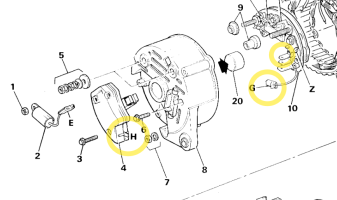
The Black wire should have a female 3/8" spade plug and be connected to the one of the two males (this is the Sense wire).
The Brown/Yellow should be connected to either of the 1/4" males (assuming they are common).

(G connects to H when assembled)
 

Attachments

  • 1757478329742.png
    1757478329742.png
    134.6 KB · Views: 70
Last edited:
jd6820

jd6820

Well-known member
The alternator is wired incorrectly. Ford were about the only manufacturer to install battery temp sensors in the bottom of the battery box. They often fail causing a no charge situation. The black wire should lead back to the battery temp sensor. Then the brown and yellow is in the wrong location and should go to the small terminal on the block of three terminals. Battery temp sensor is essentially a resistor tied back to battery positive. The voltage drop across the resistor is a specific value that controls the charging process.
 
Vinpetrol

Vinpetrol

Well-known member
Let me fix that for you - " Who f#*ked with it?"

This diagram (from the 455c ~ 655c manual) says the Brown (N) / Yellow (Y) wire is the dash light / excitation feed. It's possible feeding power into the W terminal would actually produce some output (would need to think about it while looking at an internal circuit diag.)

View attachment 75366

Need to workout what the black wire is doing, but Brown/Yellow is definitely not right

I suggest this change once the black wire is identified.

View attachment 75367

Could you please take another pic square on showing the connections?
Will do this evening . Thanks for giving this some thought by the way .
 
Vinpetrol

Vinpetrol

Well-known member
The alternator is wired incorrectly. Ford were about the only manufacturer to install battery temp sensors in the bottom of the battery box. They often fail causing a no charge situation. The black wire should lead back to the battery temp sensor. Then the brown and yellow is in the wrong location and should go to the small terminal on the block of three terminals. Battery temp sensor is essentially a resistor tied back to battery positive. The voltage drop across the resistor is a specific value that controls the charging process.
Thanks for this . I will have a look under the battery this evening and see if I can identify the battery temp sensor .
 
Vinpetrol

Vinpetrol

Well-known member
Let me fix that for you - " Who f#*ked with it?"

This diagram (from the 455c ~ 655c manual) says the Brown (N) / Yellow (Y) wire is the dash light / excitation feed. It's possible feeding power into the W terminal would actually produce some output (would need to think about it while looking at an internal circuit diag.)

View attachment 75366

Need to workout what the black wire is doing, but Brown/Yellow is definitely not right

I suggest this change once the black wire is identified.

View attachment 75367

Could you please take another pic square on showing the connections?
I haven’t had it long and it wasn’t charging when I got it .
 
Vinpetrol

Vinpetrol

Well-known member
I’ve had a look under the battery tray , it actually pivots out the way . I can’t see anything that looks like a temp sensor. There is a connector not going anywhere that has a black wire and a black and green wire going to it that may of connected to a temp sensor at some point in time .
IMG_8814.jpeg


IMG_8817.jpeg

I did find a wire that was a bit loose at the battery so connected it properly .
I checked the spade connectors on the back of the alternator and wether running or not the lower 2 of the 3 spades were both positive 12.5v
IMG_8812.jpeg

I did disconnect the battery negative lead and tested it when it wasn’t connected to the battery while the engine was running . It showed 12.6v from the positive battery terminal (still connected to battery ) and the negative terminal (disconnected from battery) I thought that this meant it was charging but I’m really not sure
 
jd6820

jd6820

Well-known member
Cheers Bud , any idea what the connector where the bottom wire is (black wire)
There in lies your issue. That Black/Green should have 12v then pass through the temp sensor (switch) and back to the alternator via the black wire. I highly doubt it will start charging even if you move the brown/yellow to the little spade terminal in the column of three terminals but it definately doesn't want to be connected to the 'W' terminal.

The idea behind the temp sensor is to prevent battery overcharging. The little block that the black wire is attached to is essentially the control mechanism that shuts off the regulator built into the alternator. Either change the alternator to one that doesn't have this feature or fit a new temperature switch.
 
Vinpetrol

Vinpetrol

Well-known member
The alternator is wired incorrectly. Ford were about the only manufacturer to install battery temp sensors in the bottom of the battery box. They often fail causing a no charge situation. The black wire should lead back to the battery temp sensor. Then the brown and yellow is in the wrong location and should go to the small terminal on the block of three terminals. Battery temp sensor is essentially a resistor tied back to battery positive. The voltage drop across the resistor is a specific value that controls the charging process.
So what wire turns the charge light on and off ?
 
Vinpetrol

Vinpetrol

Well-known member
There in lies your issue. That Black/Green should have 12v then pass through the temp sensor (switch) and back to the alternator via the black wire. I highly doubt it will start charging even if you move the brown/yellow to the little spade terminal in the column of three terminals but it definately doesn't want to be connected to the 'W' terminal.

The idea behind the temp sensor is to prevent battery overcharging. The little block that the black wire is attached to is essentially the control mechanism that shuts off the regulator built into the alternator. Either change the alternator to one that doesn't have this feature or fit a new temperature switch.
So as I’m getting 12v in the black wire I’m assuming it’s already been bypassed by someone who didn’t want to replace battery temp sensor . If this is the case , moving the brown / yelllow over to the top smaller one of the 3 terminals it should charge or does the resistor in the temp sensor alter the 12v current so much that it won’t work properly?
Assuming alternator is goosed how important is the batt temp sensor ? I’ve never heard of batteries needing to be protected from overcharging before .
I’ve fitted a new yuasa battery to it . Would modern batteries be better equipped to deal with the charging from this type alternator .
Alternatively would it be difficult to find an alternator that would fit it without the batt temp sensor input required in the original ?
 
V8Druid

V8Druid

do it as well as you can,but learn to do it better
So as I’m getting 12v in the black wire I’m assuming it’s already been bypassed by someone who didn’t want to replace battery temp sensor . If this is the case , moving the brown / yelllow over to the top smaller one of the 3 terminals it should charge or does the resistor in the temp sensor alter the 12v current so much that it won’t work properly?
Assuming alternator is goosed how important is the batt temp sensor ? I’ve never heard of batteries needing to be protected from overcharging before .
I’ve fitted a new yuasa battery to it . Would modern batteries be better equipped to deal with the charging from this type alternator .
Alternatively would it be difficult to find an alternator that would fit it without the batt temp sensor input required in the original ?
bung a std 17ACR back on there Vin -- When BL existed a trip to a scrappy would've resulted in a choice of dozens of S/h units ..
SD,s used to run a 23ACR (130A charging :giggle:) binned dozens of perfectly good 17,s 19,s and 23,s when I cleared my yard :cry::cry:
 
Vinpetrol

Vinpetrol

Well-known member
bung a std 17ACR back on there Vin -- When BL existed a trip to a scrappy would've resulted in a choice of dozens of S/h units ..
SD,s used to run a 23ACR (130A charging :giggle:) binned dozens of perfectly good 17,s 19,s and 23,s when I cleared my yard :cry::cry:
So you’re saying that the current alternator isn’t one that uses the batt temp sensor so should just charge with the 12v input from black wire so it must be goosed ? Is there a higher output option that’ll give the battery more grunt for additional lights etc
 
Gecko

Gecko

Well-known member
I haven’t had it long and it wasn’t charging when I got it .
Ah - may be part of the reason it was on the market.

That Black/Green should have 12v then pass through the temp sensor (switch) and back to the alternator via the black wire.
This can't be the case here as the B/Gr : B connector is open, yet there is 12V on the Black at the Alternator - must be a different wire.

So what wire turns the charge light on and off ?
This needs a flexible mental approach. Normally, you have a battery, switch, light, ground - the light always has 0V on the ground terminal and when you close the switch, the light has 12V on one side, 0V on the other - so it lights. Easy.
The alternator warning light is sort of the reverse. With the Ign switch ON, the light has 12V on one side and the (stationary) alternator looks like a direct connection to ground - so it lights.
Then the Alt starts to spin and the internal voltage rises. The light still has 12V on one side from the Ign. switch, but the Alt. no longer looks like a ground connection (0V), but rather a voltage source (14V). Now the light has 12V on one terminal and 14V on the other, so it sees only 2V which isn't enough to make it glow.
(this is more representative than literal as the Alt. output is connected the the battery, so the two voltages track each other much more closely than suggested)

Found this pic on a random forum in a discussion on Ford tractors (model not specified)

1757561821351.jpeg


Could you measure the resistance between these two terminals? (some diagrams show them as connected)

1757561988703.png
 
V8Druid

V8Druid

do it as well as you can,but learn to do it better
So you’re saying that the current alternator isn’t one that uses the batt temp sensor so should just charge with the 12v input from black wire so it must be goosed ? Is there a higher output option that’ll give the battery more grunt for additional lights etc
no

if you want better output, the 19ACR or better still the 23ACR will give you more - but also drag HP out of the engine to do so - also need to be aware of the pulley sizing as a petrol engine fitment will have a smaller pulley than a diesel fitment, (if they arrive with a pulley fitted - don't always)all will fit the same mounts
 
Vinpetrol

Vinpetrol

Well-known member
Ah - may be part of the reason it was on the market.


This can't be the case here as the B/Gr : B connector is open, yet there is 12V on the Black at the Alternator - must be a different wire.


This needs a flexible mental approach. Normally, you have a battery, switch, light, ground - the light always has 0V on the ground terminal and when you close the switch, the light has 12V on one side, 0V on the other - so it lights. Easy.
The alternator warning light is sort of the reverse. With the Ign switch ON, the light has 12V on one side and the (stationary) alternator looks like a direct connection to ground - so it lights.
Then the Alt starts to spin and the internal voltage rises. The light still has 12V on one side from the Ign. switch, but the Alt. no longer looks like a ground connection (0V), but rather a voltage source (14V). Now the light has 12V on one terminal and 14V on the other, so it sees only 2V which isn't enough to make it glow.
(this is more representative than literal as the Alt. output is connected the the battery, so the two voltages track each other much more closely than suggested)

Found this pic on a random forum in a discussion on Ford tractors (model not specified)

View attachment 75400

Could you measure the resistance between these two terminals? (some diagrams show them as connected)

View attachment 75401

I do have a multimeter but I don’t know how to measure resistance , how’s it done?
 
Top