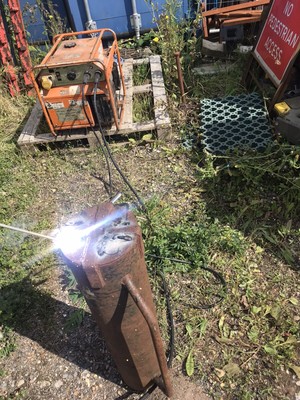
I sort of went through this a while ago, looked at an oil cooled 'Oxford' welder vs. a modern inverter. I only have single phase & not that wonderful a supply without a lot of work/money. I found that the oil cooled units were very power hungry (Needing at least a 20A dedicated socket) & only comprable to an industrial machine for smoothness if on 3ph anyway.
I went with the Pro Arc 135 inverter from R Tech (3 yr no quibble warranty) - have it running from a 16A 'blue' industrial socket wired from a disused 16A feed that once run a bathroom heater, (as nusance plug fuse blowing likely if off 13A plug on 3.25 rods)
A thing to look out for is the quoted 'open circuit voltage' (OCV) - if you want to use low hydrogen E7018 rods, for strong root runs in thick material, vertical welding, or indeed other special rods eg. Hardox. To get these rods to start needs an OCV of about 80v.
I was told that once a combined thickness of 18mm plus is to be welded the E7018's are good, & if say T butt welding 10mm plate to 12mm these thicknesses add together to be above the 18mm. There is a wealth of help & knowledge here
https://www.mig-welding.co.uk/forum/
covers far more than mig. To see what I tackled look at the Gopher Restoration on the vintage section here. I did do a short welding course about 30 yrs ago during 90's slump when on dole.
I bought a cheap 'auto darkening' helmet off Ebay, another great step forward. It is said that these inverter welders will wind down to low amps running but still have the grunt to start a rod, so thinner stuff is more poss with 1.6mm rods. Have got some to try & must when I next have the unit out. Stick will not weld anything thinner than the rod dia. so they say not less than 1.5mm thick steel. Have in the past used a twin carbon arc brazing torch on thin stuff off a stick welder. R Tech have some good advice on using an inverter on a genny. & also say keep grinding dust out of the inverter. I always switch it off & cover with cloth before grinding anywhere near it.


or more that your not at the whim of shitty overhead supply's like us