

You are using an out of date browser. It may not display this or other websites correctly.
You should upgrade or use an alternative browser.
You should upgrade or use an alternative browser.

V8Druid
do it as well as you can,but learn to do it better
pin 15 in your pic is pin 85 on today's relaysIs this ignition relay a bog standard relay ?
I can’t find one for sale with terminal 15
View attachment 75559
Vinpetrol
Well-known member
Cheers buddy , is it a bog standard 40A relay then ?pin 15 in your pic is pin 85 on today's relay

jd6820
Well-known member
jd6820
Well-known member
Just had a look at the wiring diagram. The alternator light is fed from the ignition relay. This is activated by the keyswitch via fuse 8. Worth checking this fuse is good both sides. Then check to see if the relay is activated. You could always bridge pin 30 and 87, this should then power up the dash light.

Gecko
Well-known member
In the past, 85 and 85 were interchangeable, but now (due to ECU control), many relays have a diode in them to prevent voltage spikes killing the ECU.pin 15 in your pic is pin 85 on today's relays
The result is the two terminals should no longer be considered interchangeable.
If the diode is present, then:
Pin
Pin
The easiest is to make sure you have a relay WITHOUT the diode (assuming you have no ECU), then it doesn't matter which way 85/86 are wired.
* @Canal Navvy spotted the typo
Last edited:
Vinpetrol
Well-known member
V8Druid
do it as well as you can,but learn to do it better
std 5 pin-er Vin - no diode shown in the circuit diagram impressed into the case - just about any 5 pin'll replace it (without a diode

Gecko
Well-known member
Noooo .... 86 is +vebut if you did, pin 85 is +ve and pin 86 is -ve / ground / earth
V8Druid
do it as well as you can,but learn to do it better
sh1t in my eyes this morning
Vinpetrol
Well-known member
Not a good evening this evening . This was the relay the suppliers delivered after giving them the Bosch part number on original . Would you say that this is correct ? (I’m not confident in them as they are guilty of putting anything out rather than nothing. I asked for an ignition as well and they got it wrong ).
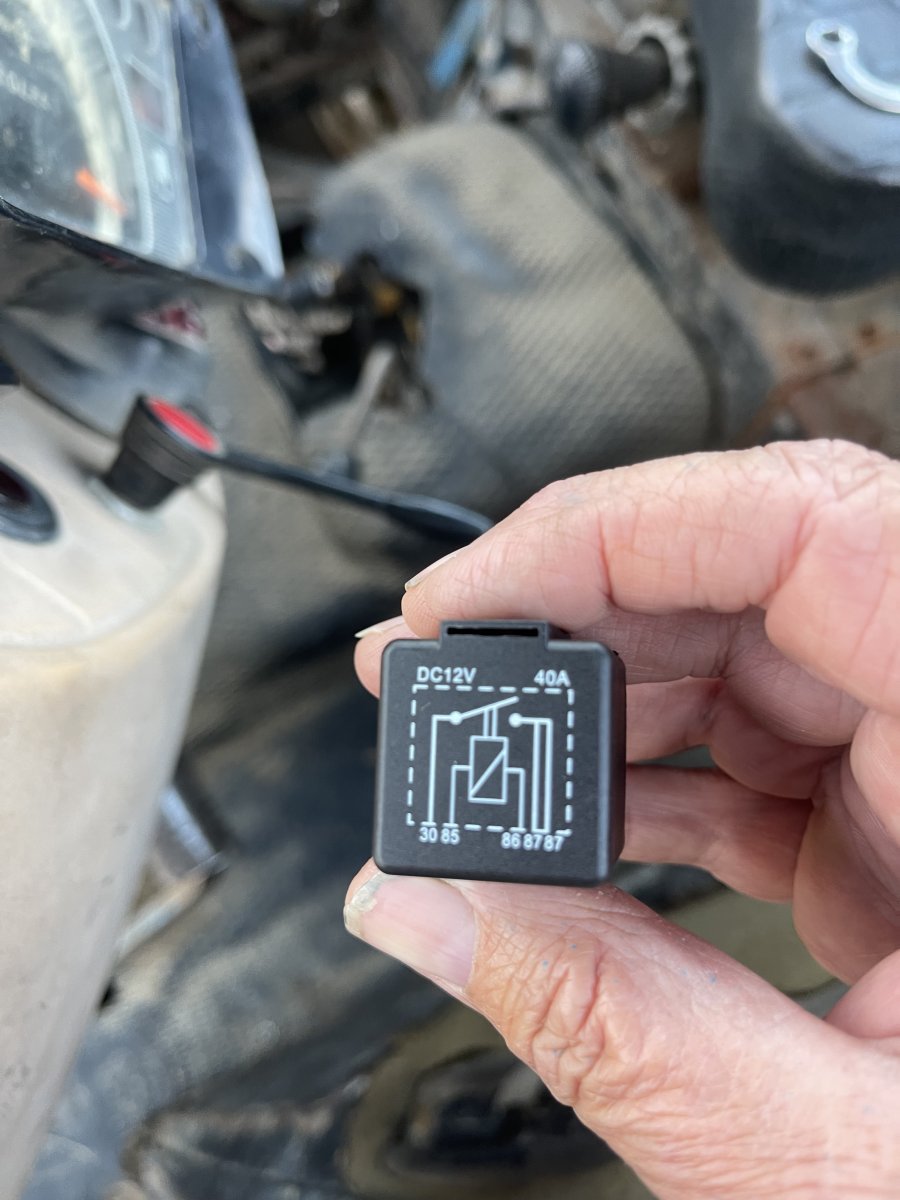
I fitted it and then tried for 12v power at dash light. There wasn’t any . Then without ignition on the hazard light relay starting clicking like hazards were on but hazard dash light wasn’t coming on . I then tried to test for power at the fuses . I was struggling to get access so I cut a couple of cable ties to free up some slack on the wiring harness. When I tried again I’d lost all power to the ignition . I’m confident I didn’t nick a cable when I cut the ties and I have power at the starter but I can’t see anything between the starter and the ignition on the wiring diagram .
It then got too dark for anything else .
Any ideas what to check ?
I fitted it and then tried for 12v power at dash light. There wasn’t any . Then without ignition on the hazard light relay starting clicking like hazards were on but hazard dash light wasn’t coming on . I then tried to test for power at the fuses . I was struggling to get access so I cut a couple of cable ties to free up some slack on the wiring harness. When I tried again I’d lost all power to the ignition . I’m confident I didn’t nick a cable when I cut the ties and I have power at the starter but I can’t see anything between the starter and the ignition on the wiring diagram .
It then got too dark for anything else .
Any ideas what to check ?
V8Druid
do it as well as you can,but learn to do it better
is that a 4 pin Vin - certainly energise to make but no 87a terminal (energise to break)Not a good evening this evening . This was the relay the suppliers delivered after giving them the Bosch part number on original . Would you say that this is correct ? (I’m not confident in them as they are guilty of putting anything out rather than nothing. I asked for an ignition as well and they got it wrong ).
View attachment 75598
I fitted it and then tried for 12v power at dash light. There wasn’t any . Then without ignition on the hazard light relay starting clicking like hazards were on but hazard dash light wasn’t coming on . I then tried to test for power at the fuses . I was struggling to get access so I cut a couple of cable ties to free up some slack on the wiring harness. When I tried again I’d lost all power to the ignition . I’m confident I didn’t nick a cable when I cut the ties and I have power at the starter but I can’t see anything between the starter and the ignition on the wiring diagram .
It then got too dark for anything else .
Any ideas what to check ?
it has two 87 terminals like the original though.
you've obviously disturbed a connection somewhere pulling the harness about
Vinpetrol
Well-known member
No it’s defo a 5 pin . Am I right in thinking that there shouldn’t be anything that can cause an issue between the starter and the ignition on the 12v live feed ?is that a 4 pin Vin - certainly energise to make but no 87a terminal (energise to break)
it has two 87 terminals like the original though.
you've obviously disturbed a connection somewhere pulling the harness about
Then as you say it must be something simple like disturbed connection .
V8Druid
do it as well as you can,but learn to do it better
yeh it has two 87 pins, like your original (but as said, no 87a) (IMHDO it's unusual to have two 87,s) - not what you'd call a 'standard' 5 pin - those without an 87a are usually just 4 pins (energise to make and no energise to break [87a] pin)No it’s defo a 5 pin . Am I right in thinking that there shouldn’t be anything that can cause an issue between the starter and the ignition on the 12v live feed ?
Then as you say it must be something simple like disturbed connection .
show us the terminal set up/view Boyo
V8Druid
do it as well as you can,but learn to do it better
basically the ign switch should have a permanent live feed (most often taken from the main pole on the starter, fed by the main HD lead from the battery) -No it’s defo a 5 pin . Am I right in thinking that there shouldn’t be anything that can cause an issue between the starter and the ignition on the 12v live feed ?
Then as you say it must be something simple like disturbed connection .
the ign switch then distributes power according to whatever position the switch is in -
first turn energises all 'ancillary' circuits including a live feed to the charge light on the dash -
second detented turn energises the heater plugs -
turn through the detented position to the third position and the starter solenoid is energised/engaged (and usually all else is de-energised to allow max voltage to the starter) -
Solenoid pulls in the dog and energises the starters HD circuit.
some circuits use a relay to energise the starter solenoid as they can draw a fair current on some starters.
So start position on the key would energise the starter relay, which will have it's own (usually) permanent live (again often fed from the main pole on the starter to avoid loading the ign switch) the ign relay then energises the solenoid, which pre-engages the starter's dog before spinning the starter up and energises the HD circuit to spin the starter motor .
Gecko
Well-known member
That relay is fine for this purpose.
The two output terminals are uncommon, but convenient when wiring (say) two work lights (saves splicing two wires into one connector)
The two output terminals are uncommon, but convenient when wiring (say) two work lights (saves splicing two wires into one connector)
Vinpetrol
Well-known member
I’ve now got power back in the dash after sorting out some wiring bodges !
I’m still trying to resolve issues just now . Can anyone tell me what each terminal does on the ignition relay ?
What I think is correct so far is
black (15) is to earth
Green (86) 12v supply from fuse 8 live when ignition is on
Brown (30) this one confuses me , the diagram seems to show that it joins onto white/yellow from ignition position 5 to starter solenoid . I need some clarification on this ? Seems strange that a 12v ignition on supply connects with 12v supply that tells the solenoid to pull in the starter ??
White (87) 12v goes through fuse 4 then changes to green and goes to dash bulbs inc alternator light
White / yellow (87) goes through fuse 15 and supplies 12v to cab heater
I’m still trying to resolve issues just now . Can anyone tell me what each terminal does on the ignition relay ?
What I think is correct so far is
black (15) is to earth
Green (86) 12v supply from fuse 8 live when ignition is on
Brown (30) this one confuses me , the diagram seems to show that it joins onto white/yellow from ignition position 5 to starter solenoid . I need some clarification on this ? Seems strange that a 12v ignition on supply connects with 12v supply that tells the solenoid to pull in the starter ??
White (87) 12v goes through fuse 4 then changes to green and goes to dash bulbs inc alternator light
White / yellow (87) goes through fuse 15 and supplies 12v to cab heater
M
muckyman
Active member
Glad that some people understand electrics its all well beyond me
Vinpetrol
Well-known member
Have a go !Glad that some people understand electrics its all well beyond me
V8Druid
do it as well as you can,but learn to do it better
85 and 86 are the solenoid coil wires in the relay VinI’ve now got power back in the dash after sorting out some wiring bodges !
I’m still trying to resolve issues just now . Can anyone tell me what each terminal does on the ignition relay ?
What I think is correct so far is
black (15) is to earth
Green (86) 12v supply from fuse 8 live when ignition is on
Brown (30) this one confuses me , the diagram seems to show that it joins onto white/yellow from ignition position 5 to starter solenoid . I need some clarification on this ? Seems strange that a 12v ignition on supply connects with 12v supply that tells the solenoid to pull in the starter ??
White (87) 12v goes through fuse 4 then changes to green and goes to dash bulbs inc alternator light
White / yellow (87) goes through fuse 15 and supplies 12v to cab heater
85 needs to go to an earth -
86 needs a live supply from the crank position on the switch - terminal 3
30 needs a constant live supply from the main starter pole, fed directly from the battery -
an/one 87 needs to feed the starter's solenoid 6mm terminal -
that will give you a crank and start when the ign switch is turned to crank -
there is no 15 on your new relay.
you need to have a constant live to terminal 1 on the ign switch (fed from the main pole on the starter again - as 30 above)
from terminal 2 on the ign switch you need a feed to one side of the charge light bulb on the dash (this becomes live on the first turn of the key)
terminal 5 supplies power to your heater plugs (or the heater plug relay if fitted) (this becomes live when you turn the key to heat position on the first detented key position)
terminal 3 feeds power to your pin 86 on the ign relay to energise the starter solenoid in the detented crank position.
terminal 4 supplies power to all your other aux/ancilliary circuits (usually through/via the fuse box distributor) - wipers, heater, indicators, radio, whatever, etc., when the ign key returns to its position 1 -- i.e. the run position
in the running position 1, on the ign switch, without the engine having been started the other side of your charge light earths through the alternator's little (6mm) terminal - once running that terminal becomes live and the bulb goes out as it no longer has an earth - the 10mm terminal(s) on the alternator require at least one connection/wire to feed the charge from there, to the main pole on the starter and thence to the battery to feed charge into it
and that's your basic start/charge circuit
Footer block 1