Canal Navvy
Well-known member
Polyfillament fibres are only for superficial plastic cracking on the surface they aren’t structural
They are useful too to add fire resistance to concrete as the fibres melt and create a pathway for trapped moisture.

Polyfillament fibres are only for superficial plastic cracking on the surface they aren’t structural
turfing if often last resort all top pitches are seeded. Most seed struggles to establish due to lack of water and nutrients.They do on the pro pitches in big rolls etc but small clubs not got the budget or tackle to lay it without getting big contractor in.
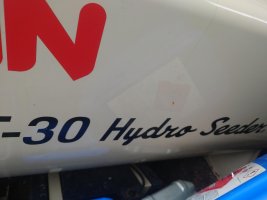
hydro-seeding certainly increases the establishment rateYou haven't got one of those as well have you ?

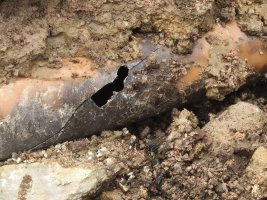
looks like that's had a hole in for quite some timeOh the joys

Selected backfillOh the joys

If you are going to power float it the fibres can be seen after.View attachment 59479
View attachment 59478
Do you lads use fibers as well as steel ?
We usually use one or the other but heard it mentioned that people often put the both in now as bibs n braces ... its for a few classic cars @ 12cm thick.
No chairs available.
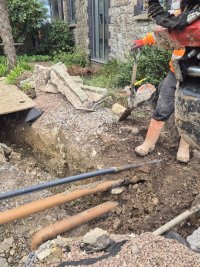
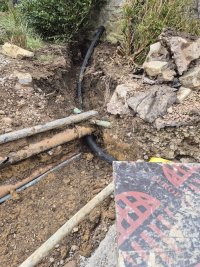
Yeah it's a mess in there, it's ok as they put a U bend inlooks like that's had a hole in for quite some time
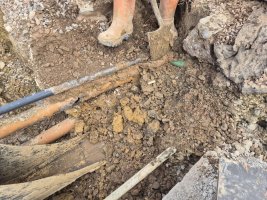
that's some rats' nest of plumbing in the last pic
 just to the right of the rodding eye
Good luck finding the metal typeMETAL FIBERS (STRUCTURAL): ADVANTAGES AND USES
These fibers are obtained from drawn steel wires.
They generally have hooks at the ends to improve their anchoring in the concrete.
They are used to improve the mechanical behavior of structural concrete (structural role). Their mechanism of action is similar to that of reinforcements (metal mesh) in ordinary reinforced concrete.
Roles in concrete:
Reduction in cracking:
By their anchoring in the concrete, the metal fibers prevent the propagation of microcracks which may be due to the natural shrinkage of the concrete or to excessive forces exerted on the structure.
Fiber-reinforced concrete: locking of a crack by the fibersLocking of a crack by the fibers.
Increase in ductility:
The presence of metallic fibers with the dosages usually used does not improve the flexural strength of concrete as such. However, after cracks appear, it allows the tensile forces to be resumed in the concrete and thus prevents it from suddenly breaking in a fragile manner. They thus give the concrete a ductile behavior.
Your money would be better spent buying some proper chairs for the meshView attachment 59479
View attachment 59478
Do you lads use fibers as well as steel ?
We usually use one or the other but heard it mentioned that people often put the both in now as bibs n braces ... its for a few classic cars @ 12cm thick.
No chairs available.

Tis a friends, he stone buried it all first and left me with it to seed after, lovely finish.. but it was super dry that year and kept getting stuck in the dust!! Speed was my friend that dayThat little seeder is nice, hired in? Or was that Pugh Lewis?

Yeah its interesting....they have sold a type of fibres over here for years, telling us its a direct replacement for mesh in lighter applications, we've been dubious so as with this job any time there was significant load on it we've gone with what we know works ie mesh, but it might well be worth putting fibers in to help with potential plastic cracking or shrinkage as they are not looking for a fancy finish, as @Steve says they can show.Good luck finding the metal type
Only seen them Once and that was a huge factory unit 100m x 60m 220mm floors on stabilised ground. Contractor had their own machine that added them to mixer, don’t think they pump too well either. I’d guess if you can get them it’s only be big city batching plants only.
Local suppliers dont do them and lbh its more than adequate for a few carsYour money would be better spent buying some proper chairs for the mesh


In the day when we done industrial flooring we used Fibres only when directed by client. Nightmare to power float finish.Yeah its interesting....they have sold a type of fibres over here for years, telling us its a direct replacement for mesh in lighter applications, we've been dubious so as with this job any time there was significant load on it we've gone with what we know works ie mesh, but it might well be worth putting fibers in to help with potential plastic cracking or shrinkage as they are not looking for a fancy finish, as @Steve says they can show.
Im well aware concrete is a bit of a black art and a specialist job if your going for the best finishes etc, while we have floated floors and got decent results in thd past nowadays we only do concrete as part of a bigger project and keep it basic, this garage is getting another finish down the line.
I dont pretend to be an expert by any means.
@Smiffy these boys rocked up 7.30am started cutting, been at it 30 mins no water big dust cloud drifting….
Looks like a bt box or virgin

Looks like subbies?A Ringway subby gang got caught doing exactly the same about a month ago by a member of public and reported to HSE. The fallout is unbelievable and because Ringway have all the training and toolbox talks in place the individuals not only got sacked but she are going to fine them.
And there traffic management is carp aswell no cones, no footway closed signs. If you tried that in Surrey you would have one hell of a fine
Thats concrete work ...everyone has a different opinionIn the day when we done industrial flooring we used Fibres only when directed by client. Nightmare to power float finish.
Used extensively on external lorry parking areas as it improves impact damage greatly. But would still use mesh as structural steel. Would definitely add Fibres to heavy duty external but would say waste of time on light duty or internal.
They really need to be added in bottle mixer at plant. Anyone adding them to a volumetric is really wasting their money. Have some more cement instead!!