Help please Fuse popping

D

Deanofire

Active member
just had a thought not sure if its relevent, when i picked up the digger the guy was getting a tracker removed from it, i cant see any connections that look after market so i gather it must have connected into the original loom ? maybe thats why the spare fuses were in ?
 
GazCro

GazCro

Well-known member
40 amp supply to a relay, 15 amp to switch it?
That's what i was getting at earlier or along those lines. My 6 tonne dumper had an intermittent fault which would trip the circuit breaker for indicator circuit now and again. Came back off hire one day blowing 40 amp main fuse. Turned out wiring to rear lights rubbed through and was shorting out hence tripping circuit but must have been a small enough short that it didn't always trip and eventually overloaded indicator relay and melted it resulting in main fuse blowing.
I get the feeling op could be looking for a minor fault which has created what looks like a bigger one.
 
Mick-the-fitter

Mick-the-fitter

It’s what I do!
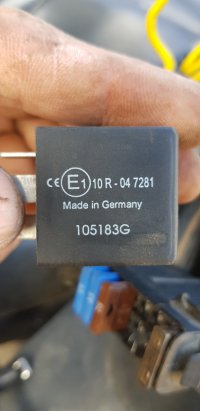
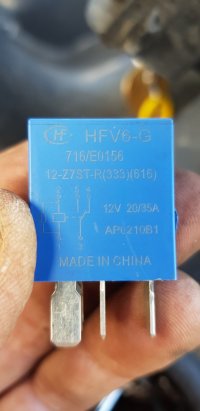
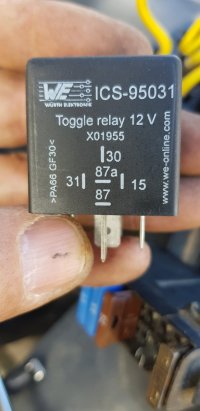
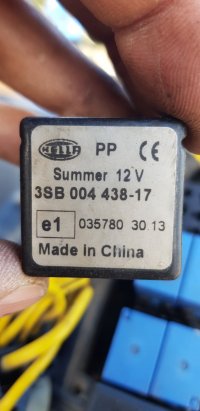
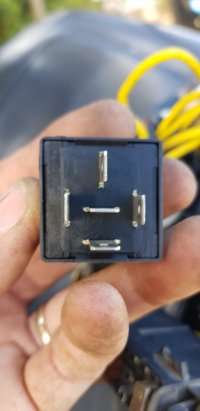
It looks like you have 5 pin micro relays on your machine, and a latching relay, this would mean if a circuit uses a micro 5 pin relay then it can have an output when switched or not! By the middle tag being fed (40amps) when the key is switched on (15amps) it has an output but also has an output on the fourth pin when switched by a switch(15amp). A latching relay is one that latches on once and when fed again latches off!
 
Mick-the-fitter

Mick-the-fitter

It’s what I do!
That's what i was getting at earlier or along those lines. My 6 tonne dumper had an intermittent fault which would trip the circuit breaker for indicator circuit now and again. Came back off hire one day blowing 40 amp main fuse. Turned out wiring to rear lights rubbed through and was shorting out hence tripping circuit but must have been a small enough short that it didn't always trip and eventually overloaded indicator relay and melted it resulting in main fuse blowing.
I get the feeling op could be looking for a minor fault which has created what looks like a bigger one.

You get the idea, I think looking at the boom light wiring, we might be getting somewhere!
 
D

Deanofire

Active member
That's what i was getting at earlier or along those lines. My 6 tonne dumper had an intermittent fault which would trip the circuit breaker for indicator circuit now and again. Came back off hire one day blowing 40 amp main fuse. Turned out wiring to rear lights rubbed through and was shorting out hence tripping circuit but must have been a small enough short that it didn't always trip and eventually overloaded indicator relay and melted it resulting in main fuse blowing.
I get the feeling op could be looking for a minor fault which has created what looks like a bigger one.
I have tried taking the fuses out one by one but still had the problem but what your saying is way over my skill set (sorry). what do you suggest i do to try and isolate the problem ?
TIA
 
D

Deanofire

Active member
It looks like you have 5 pin micro relays on your machine, and a latching relay, this would mean if a circuit uses a micro 5 pin relay then it can have an output when switched or not! By the middle tag being fed (40amps) when the key is switched on (15amps) it has an output but also has an output on the fourth pin when switched by a switch(15amp). A latching relay is one that latches on once and when fed again latches off!
 

Attachments

  • 20220409_143523.jpg
    20220409_143523.jpg
    81.2 KB · Views: 145
  • 20220409_144025.jpg
    20220409_144025.jpg
    73 KB · Views: 125
  • 20220409_143527.jpg
    20220409_143527.jpg
    96.5 KB · Views: 139
  • 20220409_143500.jpg
    20220409_143500.jpg
    95.2 KB · Views: 144
  • 20220409_143520.jpg
    20220409_143520.jpg
    68.6 KB · Views: 130
D

Deanofire

Active member
It looks like you have 5 pin micro relays on your machine, and a latching relay, this would mean if a circuit uses a micro 5 pin relay then it can have an output when switched or not! By the middle tag being fed (40amps) when the key is switched on (15amps) it has an output but also has an output on the fourth pin when switched by a switch(15amp). A latching relay is one that latches on once and when fed again latches off!
so how would i go about testing these to find the fault ? buy new relays ?
 
V8Druid

V8Druid

do it as well as you can,but learn to do it better
it just seems strange that accessory wires are blowing that have nothing connected them but the whole thing is very strange so ????
What should i try tommorow ?
Am going to look at that boom light wiring
wonder if the loom is trapped somewhere and it's all cross talking, blowing indiscriminate fuses??:unsure:
 
V8Druid

V8Druid

do it as well as you can,but learn to do it better
so how would i go about testing these to find the fault ? buy new relays ?
could try seeing if that damned 40A fuse blows with them all out for starters ..... if it does it is almost certainly a wire shorting
look to be std relays @Mick-the-fitter cheap enough to bang in 5 new ones
edit
correction 4 new ones ... just spotted the toggle relay
 
V8Druid

V8Druid

do it as well as you can,but learn to do it better


I'd test the toggling relay first to see if it's ok 'fore spending on a new one

 
V8Druid

V8Druid

do it as well as you can,but learn to do it better
I'd test the toggling relay first to see if it's ok 'fore spending on a new one

apply 12v across 85 & 86 (31 & 15 on yours) momentarily .. should make or break a circuit between 30 & 87 .... if it makes a circuit, apply 12v momentarily to 85 & 86 (31 & 15 on yours) again and it should break the circuit between 30 & 87 ... it doesn't need a voltage to sustain it's position - it latches until told to unlatch by the second application of 12v, etc., ad infinitum

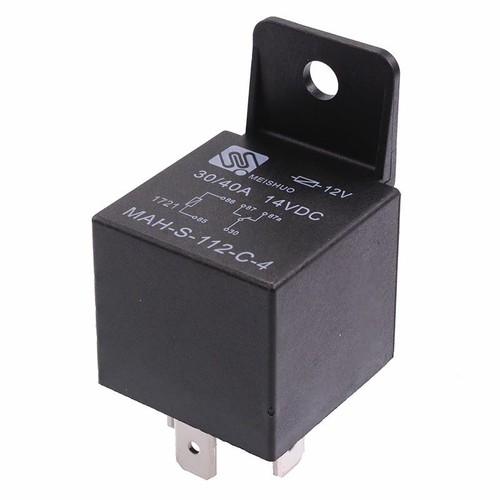
the basic relays need continuous 12v across the coils (85 & 86) to maintain their position (energised) and a circuit between 30 & 87 ... DO NOT connect anything to 87a, or 30 will supply it with power, when in the normally closed (de-energised ) position .. 30 is the live supply which gets switched by the relay to 87 and whatever is attached to that

for testing ... you'll need a 12v supply to energise the relay coil (it's an electromagnet that moves the contacts inside the relay from 87a to 87 (and vice versa with a latching/toggling relay) and a meter to determine if the 30 & 87 are making/breaking a circuit (testing for continuity)
 
Gecko

Gecko

Well-known member
wonder if the loom is trapped somewhere and it's all cross talking, blowing indiscriminate fuses??:unsure:
I'm leaning this way.

I bought a well used gen set that at some stage had lost its neg battery lead and tried to start using the return in the loom.
The result was the wire in the loom had glowed red melting the insulation of many other wires creating intermittent shorts.

If you are blowing fuses on circuits with no loads, it's a good indication either someone has played with it or there is a (several) shorts to be found.
 
Mick-the-fitter

Mick-the-fitter

It’s what I do!
I'm leaning this way.

I bought a well used gen set that at some stage had lost its neg battery lead and tried to start using the return in the loom.
The result was the wire in the loom had glowed red melting the insulation of many other wires creating intermittent shorts.

If you are blowing fuses on circuits with no loads, it's a good indication either someone has played with it or there is a (several) shorts to be found.
Thwaites Dumpers only have a small earth lead engine to chassis! So if the main battery to block bolt comes loose, there is a lot of smoke coming from the little wire when trying to start😊
 
V8Druid

V8Druid

do it as well as you can,but learn to do it better
I'm leaning this way.

I bought a well used gen set that at some stage had lost its neg battery lead and tried to start using the return in the loom.
The result was the wire in the loom had glowed red melting the insulation of many other wires creating intermittent shorts.

If you are blowing fuses on circuits with no loads, it's a good indication either someone has played with it or there is a (several) shorts to be found.
yeh seen that too ...... makes a hell of a mess of the loom
 
V8Druid

V8Druid

do it as well as you can,but learn to do it better
It’s sometimes unbelievable how much damage one hot wire can do when it’s tightly wrapped to others in a wiring harness!
not that surprising though when you have a wire glowing red amongst all the other insulated cables ... it's all going to weld together
 
D

Deanofire

Active member
Hi all, sorry for no reply today. Thought i had a result.
Cleaned the boom light plug up and insulated it, took all the fuses out , put the 40a back in and boom it didnt blow , then proceeded to put all the other fuses in one by one except the two (blower and wiper) that blew and guess what ????? it only started, put it all back together and used it for about 3 hours turning off and on, was all strong and good, then turned it off for about 3 hours to take the missus for a hospital check and cam bac, turned the key.......pop 40A fuse blew and nothing. now i am really confused...........
 
V8Druid

V8Druid

do it as well as you can,but learn to do it better
Hi all, sorry for no reply today. Thought i had a result.
Cleaned the boom light plug up and insulated it, took all the fuses out , put the 40a back in and boom it didnt blow , then proceeded to put all the other fuses in one by one except the two (blower and wiper) that blew and guess what ????? it only started, put it all back together and used it for about 3 hours turning off and on, was all strong and good, then turned it off for about 3 hours to take the missus for a hospital check and cam bac, turned the key.......pop 40A fuse blew and nothing. now i am really confused...........
possible boom light wiring then as you have obviously disturbed that whilst cleaning/isolating/insulating ... luck of the draw whilst using it and 'praps, however you parked it, shorted it again??????? :unsure: ... it's progress of sorts -- it's now intermittent ;)
trace the cabling back, paying particular attention around the king post and anything tight in the routing ..... if you can trace it back to its source and are able to - disconnect it ;) if you can determine the live line try a meter reading to earth?
 
Last edited:
Top