Carter Diggers

Status
Not open for further replies.
D

DaveDCB

Well-known member
I’m confused, new machine is broken , take it back to the dealer to fix? I have never put a spanner to a machine under warranty!

I don’t buy the dealers argument that a 6k machine is for household use only, no one in the right mind spends 6k on a machine that can only be used for 1 hour a week or it will self implode! You just hire one for £150 a week once a year to turn the veg plot over!!
 
J

Jimoz

Well-known member
I’m confused by the hired-in-plant insurance argument. The OP won’t hire to commercial users as none carry this insurance - surely domestic customers don’t either?
Me too, I occasionally hire machines and have plant hire included in my policy. I think my maximum payout is 100k and 50k for any one machine.
 
Gunners

Gunners

Well-known member
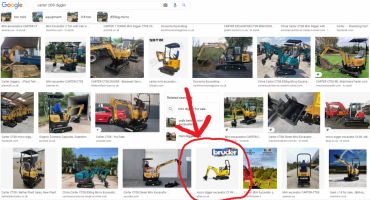
I was just on the phone to Rory about these Carter machines and thought I'd google to see what one actually looked like. As you can see they are listed with other toy diggers 😆
 

Attachments

  • carter.png
    carter.png
    1,020.4 KB · Views: 288
O

Old Operator

Well-known member
I read that only 3 Hymac 370's were built in the late 60's (one is preserved in Scotland). Poclain made an 8 tonner in the 70's but it was thought at the time that there was no marketplace for a machine of this size. Neither of these would have had front mounted blades or indeed an offset boom. The fully hydraulic 3RB was based on 10 RB running gear & I thought it a bit heavier than 7t closer to 10t? This was made between 1962 & '67 (available to order till '69 but it is not thought that one was built post '67) It had twin gear pumps & a vane slew pump. Hughes Plant of Ironbridge ran an early one till about '74 when it was sold to a big farmer. My Dad's cousin drove it.
Another early small 360 was based on the Priestman Cub - we called it the Hydro Cub, it was mechanical in slewing & travel but had an an added Vickers vane pump to run boom, dipper, bucket, rams. Some say this was the Beaver, but others say the Beaver was the same thing but fully hydraulic like Hymac. I actually drove one as a youngster. The purely mech Cub was 7t - not sure about the hybrid machine. Smith Rodley made a hybrid Smith 14 very like the Hydro Cub, one was bought by a waterways restoration trust, so pics survive - along with some Smalley stuff they owned.
In the mid 70's Priestman & Hymac used to fight for the title of greatest UK sales in the 12t market. The heavier Priestman 160 (from '73 on) was advanced - with twin axial pumps, full servo controls, but only captured 5% of the UK market - they later back tracked & made a more budget 168S with gear pumps & direct controls. Hitachi went axial pumps late '70s. It is a matter of an idea being 'of its time' - & there are 'fashions' in plant I was told. Hymac was once the market leader in Scandinavia, you would think it would have been Priestman - both on strength & where built grounds. Local contractor C.J. Pearce ran Priestmans but would not touch Hymac, seeing them more as a 'housebuilder' machine either rightly or wrongly. UK Army ran Hymacs though.
Re 'wheelbarrow' machines the Tusker Digger Dumper was once popular, simple & low cost. Winget made a slightly better one with hydraulic stabilizers (to save the driver's back, as I found out on the Thwaites)
 
JD450A

JD450A

Feral as Fk 🐾
I read that only 3 Hymac 370's were built in the late 60's

Lot more than 3, I think the number was over 100. I know of 3 alone still in existence. Worth correcting the model number was 380 (370 was a wheeldigger).
 
O

Old Operator

Well-known member
Yes JD you are right the 370 was originally Whitlock, the info that only 3 380's were built was in an article given to me in some old 'Classic Plant Machinery' Magazines. They must have got this wrong. There is also somewhere an article on a restored 3RB - even earlier than the one I remember. Going back to the Carter thing - self drive hire is the toughest of the lot because folks hire one for a day & try to get as much done as possible using it hard. On top of this the variable skill of operators. One owned by a small builder may be pushed less hard as it is always available so less time pressure. Carter is the name of a Cat dealer in the USA. I wondered if that is why the Chinese use the name?

bri963 on here replaced a slew ring on his Kubota 008, I wondered if there could be video of a slew ring that was ready to fail showing what to look out for in the used market. These are said to often fail about 5 years old / 5000 hrs ?? Reading of the Carter disaster it made me think of someone more time than money rich might get an otherwise half decent used known make machine & undertake this repair themselves. What would be the cost of a dealership doing a slew ring? Hence the saving in doing the job? Using an aftermarket ring if poss.
I think any machine is only as good as the components put into it. A digger for £4K new reflects this, as a 6 oilway European rotary union would not be less than £800, as shown by the spares for the little kit French machines. They do to be fair use all European hydraulics, & all but the most base model use a good make engine. I was urged to get a Chinese 0.8t machine by someone who should have known better. I had doubts & stuck with the Gopher rebuild. I am now very glad of this.
 
Bri963

Bri963

Well-known member
Checking a slew ring is simple. You get someone to push the bucket down until the front of the machine just lifts. If there’s any vertical movement in the bearing, it’s not far off failing altogether. Changing one out on a small machine isn’t a major problem, I did mine in my garage. When I got The old one off, I couldn’t believe the machine hadn’t parted as the last job I‘d done was stumping.
 
O

Old Operator

Well-known member
Thanks Bri963, any idea how much you saved by doing the job yourself? Am I right that they often fail about 5000 hrs? I read this in a guide to buying a used mini digger. The machine that I was urged to buy was called a Rhinoceros XN008. It contained a copy Yanmar 12Hp 1cyl
I found out that a USA importer purchased some of these engines & would break even if 50% of them lasted the 12 month guarantee period!
That alone was enough for me to back off.
 
S

Smiffy

Well-known member
Thanks Bri963, any idea how much you saved by doing the job yourself? Am I right that they often fail about 5000 hrs? I read this in a guide to buying a used mini digger. The machine that I was urged to buy was called a Rhinoceros XN008. It contained a copy Yanmar 12Hp 1cyl
I found out that a USA importer purchased some of these engines & would break even if 50% of them lasted the 12 month guarantee period!
That alone was enough for me to back off.


These things are only ever guides, I was told roughly 1000hrs per tonne of machine is the service life of an excavator before a major rebuild can be expected
 
Bri963

Bri963

Well-known member
I don’t think you can be hard and Fast on this. I did mine at 2800, but it had been limping along for a hundred or so hours. Mine is an ex-hire machine, and it needed rebushing one end to the other at the same time. If a machine has had a pecker inflicted on it, out on self-drive, it’s going to be a lot less. I doubt you’d ever get 5000 hours on this sort of machine, and wouldn’t be too surprised if a lot of small machines get scrapped instead of rework.

How much did I save? In a fully equipped shop with an overhead crane, probably a four-five hour job at workshop rates. I expect you’d get charged a full day. I was lucky and the swing pinion was okay to re-use.
 
O

Old Operator

Well-known member
Actually the guide might have more stated 5 years of age - I sort of equate that with 1000 hrs per yr, it was a while ago when I saw it. Your typical 3CX might have done 1000 hrs a year from new, many of the ownership calcs were based around this. Sorry I am that out of touch how much would the full day at workshop rates be these days? Did you mean never get 5000 hrs life on the whole machine or just the slew ring?
I would imagine that out on self drive one would almost never get any grease between hires. I used to lovingly grease our old 3C daily, it went to a farm & is still used!!
 
Bri963

Bri963

Well-known member
I doubt you’d ever get 5000 hours out of the micro bearing. However you operate and service the machine, the issue is that the diameter of the bearing is only about 350 mm so there’s a lot of leverage on it when working. If you look after a micro, I don’t see why one couldn’t last well over 5000 hours. I expect a lot get scrapped or exported because after five years they aren’t seen as worth repairing. Before Ross sorted me out, every machine I looked at had bad play in the bearing, and bushes that had lost their newness a few years ago. The one I bought the bearing was starting to go, but the price was right to cover it.

I’m interested in how JCB micros hold up.I haven’t been impressed with the 3 - 10 tonners regarding build quality, how good they are from the seat.
 
O

Old Operator

Well-known member
Thanks very much for the info. I see what you are saying re. exporting. If the labour costs are so much lower in the destination country - then to them it is well worth putting in the 'sweat equity' as they say in the states. Also in the 3rd world country currency it might be very costly to buy new. Sort of what I was getting at when I said about some of us being more time rich than money rich. I was told when training on a 3CX in late 80s that a mobile fitter was £12ph - same as hourly rate of machine! Never had to call one in, we only put components in for repair (e.g. starter motor) as between the co owners we managed most stuff ourselves - biggest job for me was clutch renewal on the 3C.
I had a thread on the old ceeform site re. a small machine for slope work, consensus was expanding tracks, long blade option, maybe add uphill weight. Pencilled in an 8018 or lighter Bobcat E14 had wide stance, never did it - family illness. Always hesitant over this part failing.
I think it is something maybe doable if it came to it. I have operated these little machines but do not know much about the economics of running one, expected lives of components, I did cost the parts for a specimen re track. Pete
 
B

Brendan

Well-known member
Likewise the last model Mustangs were a match for any Jap at the time, again price and possibly reliability did for them.
Japanese from the 80's were smashing the Mustang and arguably made some better vehicles in the 70's and not just looks. By the late 80's the Mustang was left behind
 
Bri963

Bri963

Well-known member
I operated what would have been one of the last Priestmans, about 15 tonnes,with joysticks and pilot hydraulics, and from the seat it was a match for the same size Fiat-Hitachis or Komatsus. A lot of this is our personal opinions, and I wouldn’t get in a dispute about running costs or reliability. End of the day, we managed to dig a lot of holes with all of these machines, even Smalleys.
 
B

Brendan

Well-known member
Are the carter micros still the same, with fixed width tracks at around 900mm wide and no boom swing?
 
craig

craig

Well-known member
Speaking of older Japanese machines, I seem to recall working a komatsu it would of been a 180 or 210 not sure on dash. but blue and yellow colour scheme, with a wind up door window (like a car), never seen one since, is my mind tricking me? :ROFLMAO:
 
Status
Not open for further replies.
Top