L
LKSF
Pennine Hillbilly
I think there is a lot of enjoyment to be had from learning new things. Before last September i'd never owned, driven or fixed a 4 x 4, an excavator, a dumper. Had never come across a Victorian land drain, had a field which floods and god knows how many other interesting experiences.
So we've taken on a place halfway down a hill on the Pennines. In Winter it's very wet and windy and it wants to join us in the house and flood the fields.
Centuries ago all this was forest, but as mankind progressed all the trees came down to make way for open land to graze cattle on, this was known as 'Disafforestation' and has led to various problems, some of them being clay, wet and boggy land which is of poor quality.
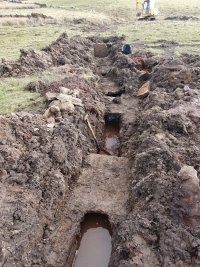
The Victorians invented land drainage, they didn't have plastic pipes back then and labour was cheap, material expensive. They watched the land and the rain before setting to work by digging trenches. In these they laid a set of flat stones like a path to a fall (although I believe some drainage didn't have these as a base, but failed because of this) on either side of these they built a dry stone wall. This was then capped off with a flat stone on top and the soil put back over it.
So you basically had a stone tunnel to carry the water from A to B and also for it to seep in from the sides to drain the land around it so it works just like it's modern equivalent, the perforated land drainage pipe.
The work they put in to do this was vast, you yourself probably know how tough it is digging through clay with a machine, (I do!) imagine doing it by hand and then building stone tunnels in there too.
Here i've dug down to expose the capping stone and am levering it off to find something which is circa 150yrs old, but still running fine:
Looking through it:
They are known as 'Soughs' and are placed in strategic places under the fields all over the place. I've had to learn how to read a field to find them, but even then many are still undiscovered.
The best ones work on the principle that when it really does rain and snow heavily the water rushes through at such a rate it flushes them out. Of course this can't happen to all of them, especially when the ground doesn't have much fall on it so they can become blocked. Some just naturally collapse for various reasons, others have been flattened in places due to modern heavy tractors being driven over them.
Then you've got problems.
If you were to map out the soughs on your fields it would look like a road map of the UK, this Sough ^ I've named the M1. It meanders from top to bottom and takes a lot of water. At peak flow it will shift more than a 3" drainage pipe can handle when totally full and flowing. I know this as someone has tried to fix it by putting such a pipe in, but it hasn't worked, it still bubbles up and goes overland.
This is Terry:
Terry isn't happy and neither am I. Two weeks previous we were scampering through that just fine, but after a struggle that day he was up to his axles in it.
Terry's mate came to pull him out as he had a lift kit, winch and better tyres. Rock hard:
Terry's mate also got stuck, I didn't have the JCB back then.
These are some of the tools we used to drag them both out:
Some of you will recognise a ground anchor (which I made), but it wasn't 100% effective. The ground was so soft it pulled it through and out when we coupled the winch up to it. In the end we had more success hammering the steel pole in and winching off that.
We started at lunchtime thinking in a few hrs we'd be done, we finally got free at 10pm on one cold, wet Winters night. Both covered head to toe in wet mud.
I'd previously warned him he could well end up staying the night here!
That's probably why he never gave up. I helped out and tethered Terry to the back of his as we dragged everything slowly back up the hills to the old farmhouse.
More to follow if you're interested?
Last edited: