Fork attachments & reverse bucket use.

Left hooker

Left hooker

Well-known member
Just sketched the swing arcs of a hinged jaw hitch to see what it would look like
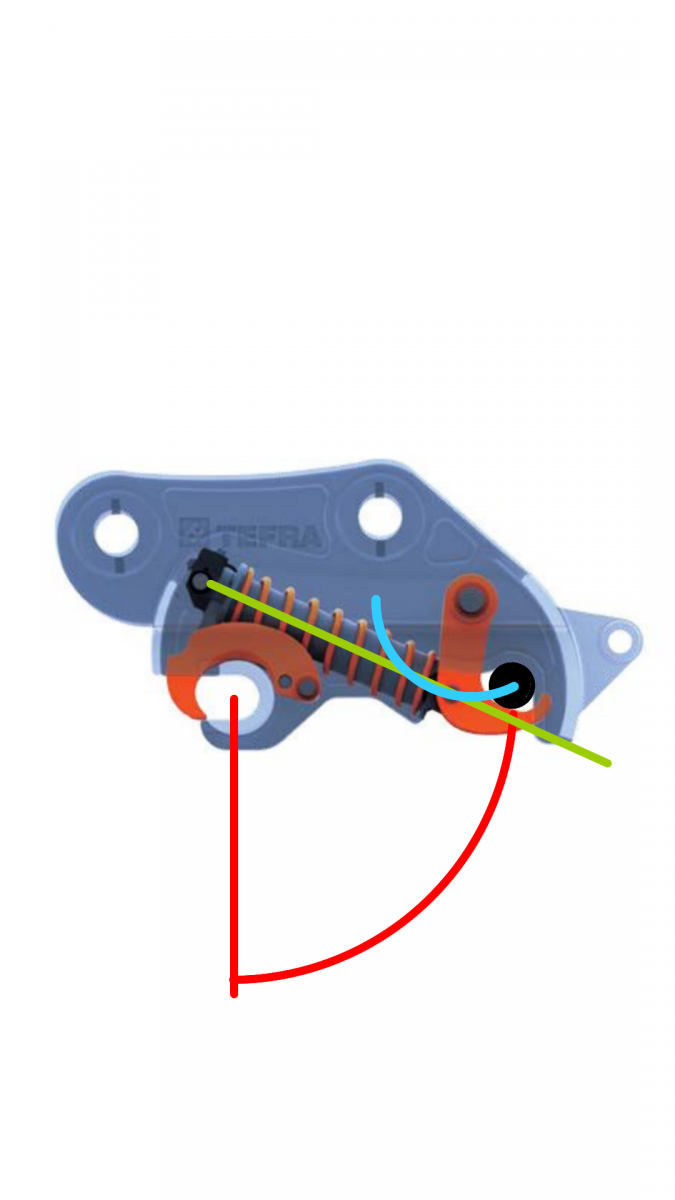
sketch-1606431540761.png
 
Bri963

Bri963

Well-known member
With a Miller/Cat, you could overcome the hitch ram, but it’s backed up with a latch that won’t allow the ram to retract until the hitch is curled right under. I wouldn’t call it good practise, though, and long-term it wouldn’t be good for the hitch. I’ve got to say in my decades of lever-pulling, I’ve never had to reverse the bucket to do a job. Must have been lucky and either had the job planned round the machine or had the right machine for the job. On a side note, the old Ackermans had two different sized pins so you couldn’t reverse the bucket.

Rory, you say a competent op. should be able to read the load chart and extrapolate for using forks. That’s not an operator’s responsibility or legal right to do and if it led to an accident, said op. would be in a world of s**t for operating outside of manufacturer’s guidance. I.e. if it isn’t written down or sanctioned, you can’t defend it in a court of law. Always worth bearing in mind, as the world is what it is, not what we think it should be.
 
V8Druid

V8Druid

do it as well as you can,but learn to do it better
With a Miller/Cat, you could overcome the hitch ram, but it’s backed up with a latch that won’t allow the ram to retract until the hitch is curled right under. I wouldn’t call it good practise, though, and long-term it wouldn’t be good for the hitch. I’ve got to say in my decades of lever-pulling, I’ve never had to reverse the bucket to do a job. Must have been lucky and either had the job planned round the machine or had the right machine for the job. On a side note, the old Ackermans had two different sized pins so you couldn’t reverse the bucket.

Rory, you say a competent op. should be able to read the load chart and extrapolate for using forks. That’s not an operator’s responsibility or legal right to do and if it led to an accident, said op. would be in a world of s**t for operating outside of manufacturer’s guidance. I.e. if it isn’t written down or sanctioned, you can’t defend it in a court of law. Always worth bearing in mind, as the world is what it is, not what we think it should be.
only if there is no check valve ..... my Hill and Miller both have checks, as does the old Lemac I have sat, but that's a slider anyway, so impossible to push back
 
Storrsy

Storrsy

Well-known member
and if they still had a manually fitted safety pin .... there'd be no issues
Some hitches like the wedge lock though, if the buckets reversed all t he weight and leverage is applied directly to the wedge itself- it’s not uncommon on my wedgelock hitches for the wedge to work a little loose during use either...
 
V8Druid

V8Druid

do it as well as you can,but learn to do it better
If blue and red lines were similar it wouldn't take much
sorry Stu ... totally disagree the thrust is in the downward direction as per black arrow, as good as and not in the direction your blue radius line puts it.
The mechanical advantage that the hitch has is huge ... as I say, IMHDO, the jaw would probably break before the thrust overcame the ram
sketch-1606431540761.png
 
JD450A

JD450A

Feral as Fk 🐾
Rory, you say a competent op. should be able to read the load chart and extrapolate for using forks. That’s not an operator’s responsibility or legal right to do and if it led to an accident, said op. would be in a world of s**t for operating outside of manufacturer’s guidance.
NOCN would seem not to agree. There guidance for fitting a attachment to a machine is of the load chart isn't present for that particular attachment then the weight of the attachment should be known and the operator should de rate from the chart.

Likewise with forklifts if the load center is different from the manufacturers point the operator is expected to derate accordingly.

Not saying your wrong at all. Your quite right. But this is the grey area that no one is addressing and either want to blanket ban or ignore.
 

Attachments

  • Screenshot_20201127-054540.png
    Screenshot_20201127-054540.png
    672.1 KB · Views: 189
  • Screenshot_20201127-054654.png
    Screenshot_20201127-054654.png
    653.6 KB · Views: 178
S

Smiffy

Well-known member
sorry Stu ... totally disagree the thrust is in the downward direction as per black arrow, as good as and not in the direction your blue radius line puts it.
The mechanical advantage that the hitch has is huge ... as I say, IMHDO, the jaw would probably break before the thrust overcame the ram
View attachment 19658

Regardless of the exact direction of force the hooked end of that rear jaw would stop it opening as the pin would catch in the jaw almost pulling the jaw shut again
 
Bri963

Bri963

Well-known member
it’s there on page 2, Rory. “However, if the manufacturer’s data is not known, guidance states that the excavator must not be used for lifting”. Again it’s good to have these conversations. Shows people are thinking about things.
 
Bri963

Bri963

Well-known member
Regardless of the exact direction of force the hooked end of that rear jaw would stop it opening as the pin would catch in the jaw almost pulling the jaw shut again

It wouldn’t release, but in normal operation all of the force is transferred up to the main casting, whereas with the bucket reversed, you have the much smaller jaw and ram pins taking the force, which long-term will wear them much faster. But then I suppose if a reversed bucket was needed long term, you’d be using a face shovel. Be honest, reversing to skip a bit of concrete isn’t going to hurt anything, except possibly the bucket ram.
 
V8Druid

V8Druid

do it as well as you can,but learn to do it better
It wouldn’t release, but in normal operation all of the force is transferred up to the main casting, whereas with the bucket reversed, you have the much smaller jaw and ram pins taking the force, which long-term will wear them much faster. But then I suppose if a reversed bucket was needed long term, you’d be using a face shovel. Be honest, reversing to skip a bit of concrete isn’t going to hurt anything, except possibly the bucket ram.
the bigger issues arise Bri with the use of forks, which'd load the hitches more dramatically and as you say, load the hitch jaws in ways they're not designed for
 
Left hooker

Left hooker

Well-known member
sorry Stu ... totally disagree the thrust is in the downward direction as per black arrow, as good as and not in the direction your blue radius line puts it.
The mechanical advantage that the hitch has is huge ... as I say, IMHDO, the jaw would probably break before the thrust overcame the ram
View attachment 19658
The blue line is the swing radius of the jaw hing pin and the ram mounting position
 
Bri963

Bri963

Well-known member
the bigger issues arise Bri with the use of forks, which'd load the hitches more dramatically and as you say, load the hitch jaws in ways they're not designed for
Gra, this scenario the forks are the weakest link, not the hitch. You don’t tend to shock load forks the way you do a bucket. Mind you, some of the pilots that I’ve seen......
 
R

Rob65

Well-known member
There is lots of talk here about the forces from using forks, but the forces applied using forks are generally fairly gradual given the nature of the lifting and placing job.

Can I draw everyone’s attention to demolition for a minute as let’s face it, that has got to be one of the harshest uses for any machine.

A rotating hydraulic demolition tool such as a shear or concon say, a 21te machine typically weighs north of 2te and when used on a horizontal floor for example applies huge forces to the bucket pin.

Quick hitches are in common use in the demolition industry and I’m not aware of there being a track record of attachments falling off machines.

Loading out a bucket full of loose muck with a forward facing bucket or picking and placing a pallet of bricks is not going to be anywhere as near as stressful as demolition work for a quick hitch.

No one has mentioned the forces and impact energy put into a quick hitch locking mechanism from a hydraulic hammer but let’s no do there.

The above is not intended to be confrontational so please don’t let it start a ‘heated debate’’.

I think the ‘Take Home Learning’ is, yes forks and reversed buckets do put more force on the locking mechanism in a quick hitch than conventional use but, that force in still less that they regularly get in demolition work.

Read into that what you will 😄😄😄

Rob
 
Bri963

Bri963

Well-known member
Well perhaps no one has mentioned it because it’s a bit removed from the original poster’s question, wherever she’s got to. I think we’re all aware of demo operations , but perhaps we’re not all aware that they did have a lot of issues with attachments falling off when quick hitches first came into use. A lot (not all) demo attachments use grut big wedge locks rather than pin grabbers, and as has already been mentioned here if you read back, wedge locks are a bit more robust when used in the opposite direction. Even with pin grabbers, the risk isn’t so much catastrophic failure as increased wear leading to component failure. Anyway Rob, good points well made.
 
Storrsy

Storrsy

Well-known member
Perhaps we should all just use good old manual semi quick hitch. The ones where you pull out the back pin- totally fail safe and probably the strongest hitch is using the bucket in reverse..!?I’d actually sooner one of these than than a spring hitch anyway for smaller machines.
 
JD450A

JD450A

Feral as Fk 🐾
Perhaps we should all just use good old manual semi quick hitch. The ones where you pull out the back pin- totally fail safe and probably the strongest hitch is using the bucket in reverse..!?I’d actually sooner one of these than than a spring hitch anyway for smaller machines.

Just pin the buckets on. Not hard if your skilled
 
Top