Bit of Concreting advise

Furniss

Furniss

Well-known member
O.K on the mesh - I suppose usually my control cuts dont touch the steel and yes thats it, the object is to control where it cracks as you say. One or two of the various slabs areas coincide with where I could put a control cut but not all - its 240m2 room divided up by arched openings so I will look to cut across shortest runs etc.

So if it is only a control crack should we be adding in expansion cracks or that foam that comes on a roll that sticks on the dpm around the walls ??

I few years ago when we had had some issues with slabs cracking I did a lot of research online into correct techniques for concreting and found so many different opinions I ended up coming to the conclusion its something that you do your utmost with the prep work and then what happens happens, (I heard that "there are only two types of concrete" saying then) often you look around concreting jobs and you see despite someone putting a control cut somewhere logical it has gone and cracked right next to the cut :rolleyes:.... anyhow eventually the misses got sick of me pointing out concreting things when we were out and about so I slowly cured myself (Boom Boom)
 
Shovelhands

Shovelhands

Well-known member
O.K on the mesh - I suppose usually my control cuts dont touch the steel and yes thats it, the object is to control where it cracks as you say. One or two of the various slabs areas coincide with where I could put a control cut but not all - its 240m2 room divided up by arched openings so I will look to cut across shortest runs etc.

So if it is only a control crack should we be adding in expansion cracks or that foam that comes on a roll that sticks on the dpm around the walls ??

I few years ago when we had had some issues with slabs cracking I did a lot of research online into correct techniques for concreting and found so many different opinions I ended up coming to the conclusion its something that you do your utmost with the prep work and then what happens happens, (I heard that "there are only two types of concrete" saying then) often you look around concreting jobs and you see despite someone putting a control cut somewhere logical it has gone and cracked right next to the cut :rolleyes:.... anyhow eventually the misses got sick of me pointing out concreting things when we were out and about so I slowly cured myself (Boom Boom)
I’d put expansion around the walls for sure.
Can you pour it all in one go? This often determines if you put an expansion in, I’d put an expansion joint across a doorway I think, if I had to have one. But definitely use dowel bars if you do, possibly have the slab a bit thicker at the joints if you do though. This might not be possible if you are going over an existing slab and depth is critical. K Form would possibly work well for the expansion joints.
 
Furniss

Furniss

Well-known member
I’d put expansion around the walls for sure.
Can you pour it all in one go? This often determines if you put an expansion in, I’d put an expansion joint across a doorway I think, if I had to have one. But definitely use dowel bars if you do, possibly have the slab a bit thicker at the joints if you do though. This might not be possible if you are going over an existing slab and depth is critical. K Form would possibly work well for the expansion joints.
Its about 29m3 and hoping to do it in one pour.
Over here they do a roll of thin foam that is adhesive backed and you can go round the room sticking that against the wall/dpm - but I thought this was as much a thermal break for an insulated slab as anything ?
We have used a K form type product before but IIRC it was a PITA to keep in position etc and didnt want to over complicate it .... seems like you can go on and on
Client did ask me if we fill control cracks with anything ?? I have heard some people fill them with mastic but I have never bothered but its always been barn floors etc,
do you put anything in the cuts afterward ?
 
Shovelhands

Shovelhands

Well-known member
I use a polyurethane sealant for the joints. Everbuild Hybriflex iirc, bit of practice and you can make a tidy job of it.

K Form has its place, it’s not a magic wand, and needs to be used correctly imo, it’s not the solution everywhere. But it does make a reasonable expansion joint that once the top strip is removed, can be mastic jointed fairly easily, as it’s usually clean, no cutting ect, unless you’ve got concrete over the top of the joint, then it needs trimming out.
 
Gunners

Gunners

Well-known member
I assume from the photo that the slab is to be under cover in that barn, so cracking from drying too fast shouldn't be an issue, and in my opinion, rules out the need for fibres. As James says, having a slab partly on an existing slab and partly on the dirt isn't ideal but for the intended use, it will be fine. I would build the dirt area up to the level of the slab with compacted crush or type 1. This will save you money on concrete. Then for pedestrian use, a 100mm slab with single layer A142 mesh, poured with RC25 mix will be fine. If you can get the customer to upspec it a bit to future proof, then I would go for a 150mm slab, single layer B785 mesh with RC35 mix. That would happily take cars, small tractors etc and is usually what I get asked to install in garages etc.
From my experience, either of these two designs will be adequate for what you have described, just remember to put somewhere in your quote that you are not a designer and therefore take no liability for design or any issues arising from it!
As for control joints, the jury is out on them indoors for me. The sun wont get to it so it shouldn't expand really, and like others, I've had concrete crack with and without them. More so from drying too fast in the sun to be honest but you wont have that problem.
As for Polythene, I always use it under concrete. If you don't it will be very hard to get a nice finish as the dry dirt under sucks all the moisture away from the surface and it becomes very difficult to achieve a fine finish. Obviously this will require a small sand blinding before you lay it to avoid puncturing the polythene.

Let us know how you get on
 
Furniss

Furniss

Well-known member
I assume from the photo that the slab is to be under cover in that barn, so cracking from drying too fast shouldn't be an issue, and in my opinion, rules out the need for fibres. As James says, having a slab partly on an existing slab and partly on the dirt isn't ideal but for the intended use, it will be fine. I would build the dirt area up to the level of the slab with compacted crush or type 1. This will save you money on concrete. Then for pedestrian use, a 100mm slab with single layer A142 mesh, poured with RC25 mix will be fine. If you can get the customer to upspec it a bit to future proof, then I would go for a 150mm slab, single layer B785 mesh with RC35 mix. That would happily take cars, small tractors etc and is usually what I get asked to install in garages etc.
From my experience, either of these two designs will be adequate for what you have described, just remember to put somewhere in your quote that you are not a designer and therefore take no liability for design or any issues arising from it!
As for control joints, the jury is out on them indoors for me. The sun wont get to it so it shouldn't expand really, and like others, I've had concrete crack with and without them. More so from drying too fast in the sun to be honest but you wont have that problem.
As for Polythene, I always use it under concrete. If you don't it will be very hard to get a nice finish as the dry dirt under sucks all the moisture away from the surface and it becomes very difficult to achieve a fine finish. Obviously this will require a small sand blinding before you lay it to avoid puncturing the polythene.

Let us know how you get on

Interesting how many different ideas - specs and experiences people have had with concrete ...... its undercover so yes surface shrinkage from sun and wind shouldnt be a prob - I also have had slabs that crack with control joints and then have laid others where customers didnt want cuts and they have had no cracking yet several years later - difficult to understand the product.

So will go DPM - expansion around the outside - light mesh - C25 - small gravel - and put some control cuts in asap ( If I can where we come from slab to stone)
then it will do what it wants no doubt :rolleyes:
 
diggerjones

diggerjones

Well-known member
We just leave gaps in mesh where control crack cuts are
 
D

DaveDCB

Well-known member
We just leave gaps in mesh where control crack cuts are
No need to do that, cuts are only for contraction when curing, may as well not bother with mesh if your going to cut all the way through it! I work on 1/5 the slab thickness for cut depth, so shouldn’t be near the mesh 🤞
 
Furniss

Furniss

Well-known member
No need to do that, cuts are only for contraction when curing, may as well not bother with mesh if your going to cut all the way through it! I work on 1/5 the slab thickness for cut depth, so shouldn’t be near the mesh 🤞
1/5th .... I always thought 2/3rd so it made the concrete really want to crack there as oppose to elsewhere :unsure:
 
D

DaveDCB

Well-known member
1/5th .... I always thought 2/3rd so it made the concrete really want to crack there as oppose to elsewhere :unsure:
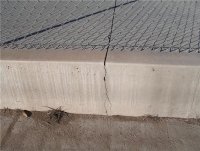
Not my photo, but shows if you give it somewhere to go it will crack at a given point 👍🏼
 

Attachments

  • 4B390B20-1F15-4215-9E27-1186DC100245.jpeg
    4B390B20-1F15-4215-9E27-1186DC100245.jpeg
    104.4 KB · Views: 255
T whiting

T whiting

Well-known member
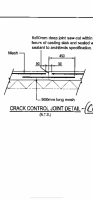
A groove with a grooving trowel is enough to make it crack on a controlled place and the theory says the mesh should be stopped 6" either side of the joint then have dowel bars with sleeves on one side to stop it gripping
 
Shovelhands

Shovelhands

Well-known member
A groove with a grooving trowel is enough to make it crack on a controlled place and the theory says the mesh should be stopped 6" either side of the joint then have dowel bars with sleeves on one side to stop it gripping
Then you might as well have a proper joint? It’s not an easy task to set up the dowel bars in mid air, in theory they can be wired to the mesh I suppose, but practicality of this might be different? Personally I don’t see the point in that if it’s just a crack inducing joint/cut. Might has well have the mesh right through the joint.
 
Jimbo69

Jimbo69

Well-known member
This is the detail for crack control joints on a floor I priced last year.
 

Attachments

  • 7FBFF5EA-0E6B-4BBD-BF64-65D49CF0AB28.png
    7FBFF5EA-0E6B-4BBD-BF64-65D49CF0AB28.png
    248.5 KB · Views: 265
T whiting

T whiting

Well-known member
Then you might as well have a proper joint? It’s not an easy task to set up the dowel bars in mid air, in theory they can be wired to the mesh I suppose, but practicality of this might be different? Personally I don’t see the point in that if it’s just a crack inducing joint/cut. Might has well have the mesh right through the joint.
Yes pretty much the easiest way to do them is to wire them to the right size chair on either side
 
diggerjones

diggerjones

Well-known member
No need to do that, cuts are only for contraction when curing, may as well not bother with mesh if your going to cut all the way through it! I work on 1/5 the slab thickness for cut depth, so shouldn’t be near the mesh 🤞
These are for controlled cracks not contraction dave.
 
V

Volbar1

Member
As said already, 100mm of concrete with 142 mesh , laid on poly with exp board around perimeter.
Concrete is only as good as the ground underneath it. External We would control cut joints in a slab using a t bar at least 1/3 depth not more than an hour after laying as a couple of hours after laying the concrete has already decided where it's going to crack, generally cutting the joint the next day is too late.
Would always seal joints externally as rain water would seep through the crack and turn the ground underneath boggy resulting in cracked broken concrete especially if heavy trafficed.
 
Top