Retaining walls?

V8Druid

V8Druid

do it as well as you can,but learn to do it better
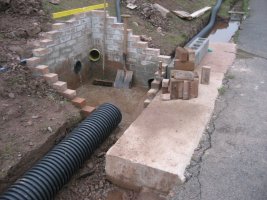
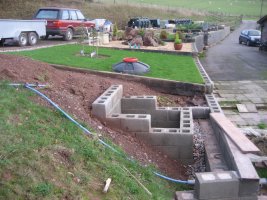
as said ..... plenty of drainage at base behind any retainer .... wall beside my drive fell over, 'fore my ownership .. virtually zero drainage ... when i replaced the wall there was plenty of drainage and clean 40 went in behind it
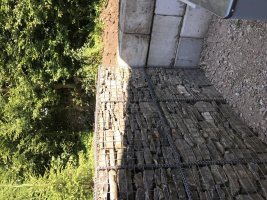
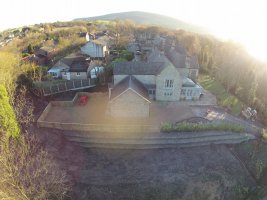
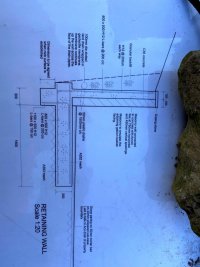
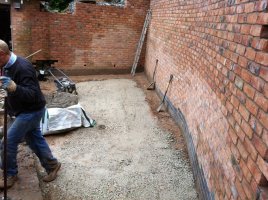
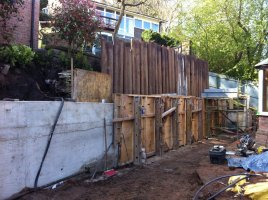
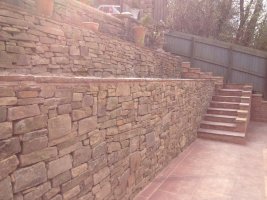
IMG_2957.jpg IMG_3044.jpg IMG_3036.jpg IMG_2976.jpg
 
Jimbo69

Jimbo69

Well-known member
as said ..... plenty of drainage at base behind any retainer .... wall beside my drive fell over, 'fore my ownership .. virtually zero drainage ... when i replaced the wall there was plenty of drainage and clean 40 went in behind it
View attachment 30154 View attachment 30157 View attachment 30156 View attachment 30155
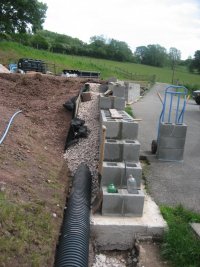
That’s my go to. Perforated pipe at the bottom and 4m clean right to the top. I’ve seen a lot of walls use that method but forget to connect the drain into anything and create an underground swimming pool behind the wall 😡
 
V8Druid

V8Druid

do it as well as you can,but learn to do it better
That’s my go to. Perforated pipe at the bottom and 4m clean right to the top. I’ve seen a lot of walls use that method but forget to connect the drain into anything and create an underground swimming pool behind the wall 😡
Oh that's connected all over the place Jimbo .... couple of collection/attenuation sumps and out into the field drains below ...... takes some sort of water when it pees down here

IMG_2961.jpg IMG_3245.jpg IMG_3246.jpg
 
Quattromike

Quattromike

Well member-known
over 450mm
Where are you guys getting this spec?
HSE look for edge protection where ever there is a risk of falling from height. This can be as little as one step. I've seen railings going up along an 8" step in the ground 🤔
 
L

Lynchy

Well-known member
Typical rail 'overkill'!
 

Attachments

  • 37104503_10213863757562940_7266888904517615616_n.jpg
    37104503_10213863757562940_7266888904517615616_n.jpg
    144.3 KB · Views: 271
  • 36434349_10213778133062381_4523931354009698304_n.jpg
    36434349_10213778133062381_4523931354009698304_n.jpg
    152.9 KB · Views: 290
V8Druid

V8Druid

do it as well as you can,but learn to do it better
Where are you guys getting this spec?
HSE look for edge protection where ever there is a risk of falling from height. This can be as little as one step. I've seen railings going up along an 8" step in the ground 🤔
always used to be 450mm/18" was the reg. ...... maybe been updated since i was doing fencing/railings ... min1100 high on the horizontal, 900mm on the rake, no gap to pass a 100mm sphere
 
Vinpetrol

Vinpetrol

Well-known member
If you stick with the remit the base is a third of the height you won’t go far wrong . Put drainage behind it all the way to the surface and weep holes in it for the water to escape to eliminate hydraulic pressure . Corners will make it even stronger
 
Giles

Giles

Well-known member
as said ..... plenty of drainage at base behind any retainer .... wall beside my drive fell over, 'fore my ownership .. virtually zero drainage ... when i replaced the wall there was plenty of drainage and clean 40 went in behind it
View attachment 30154 View attachment 30157 View attachment 30156 View attachment 30155
That footing isn’t wide enough for a retaining wall the rule is 2/3 the height width of the footing for overturning too many builders and Brickies do them like strip footings for normal walls
 
Last edited:
Giles

Giles

Well-known member
I’ve got 3 now of the max rebar guns best thing since sliced bread, used to tie by hand don’t miss the sore wrist and infected fingers from all the wire cuts from rusty wire.

don’t tie it as tight as proper steel fixers but for slabs and walls fantastic bits of kit. 10 mins training anyone can use them, got small and big ones.

we were doing loads of 16mm meshes for foundations in factories so 400+ ties in each. Started off welding but hot works etc, got the guns 1 guy 1 in each hand knock out a 4mx4m in under an hour

@Giles has got a much fancier one than that :giggle::giggle:
 
Vinpetrol

Vinpetrol

Well-known member
That footing isn’t wide enough for a retaining wall the rule is 2/3 the height width of the footing for overturning too many builders and Brickies do them like strip footings for normal walls
I didn’t see picture of found , I just replied to first post .
my fault for skipping through the thread 🙄
 
GazCro

GazCro

Well-known member
That footing isn’t wide enough for a retaining wall the rule is 2/3 the height width of the footing for overturning too many builders and Brickies do them like strip footings for normal walls
You can go 4 times the width of the wall high without engineers drawing involvement as well (have had bc ok this) but the key with any retaining wall is the bond between the wall and the footing. Dense blocks laid flat make a surprisingly strong wall (stronger than a poorly built hollow block wall imho) but the join to the footing is the weak point.
 
Giles

Giles

Well-known member
I’m like @Gunners done nearly every style of retaining wall and fixed a few failing ones, 1 rule is engineer designs it or we suggest to the engineer how we want to to do it and he does the math.

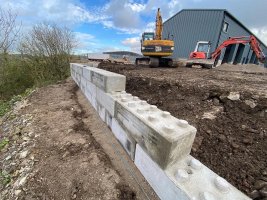
some good hand lay systems like the cribbing and the American style interlocking concrete blocks ones

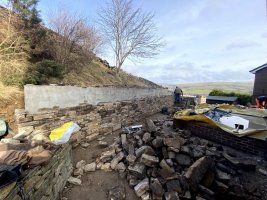
we do a lot of cast in situ concrete walls then clad in stone they work well but need experience in steel fixing shuttering erc, everyone thinks Gabion are cheap and quick but in order to get them looking great you need to spend the time hand stacking and straightening then you have sharp wires that catch on everything.

weve done a few now with precast concrete panels placed into rsjs then clad in stone

lego blocks are good but heavy 5.5 will lift close in but really need 8 or 13 ton, they don’t look the best when done but are super quick, £60 a block from my supplier.

done some of the 4“ round posts as well driven in next to each other or sleepers on end or fixed to concrete post behind etc

as has been said relieving water pressure with drains and weep holes is critical
 

Attachments

  • D2939A95-CDF9-4109-A48B-95A49DAC5BDC.jpeg
    D2939A95-CDF9-4109-A48B-95A49DAC5BDC.jpeg
    487.2 KB · Views: 262
  • FE6BD84D-2CC5-4E91-A1A9-E9481DB68B32.jpeg
    FE6BD84D-2CC5-4E91-A1A9-E9481DB68B32.jpeg
    438.1 KB · Views: 286
  • 631EC58C-FC0B-4B69-A3E7-C5F3C96AB84E.jpeg
    631EC58C-FC0B-4B69-A3E7-C5F3C96AB84E.jpeg
    299.1 KB · Views: 255
  • C01806D9-1756-416B-A7F2-523DF421FDBB.jpeg
    C01806D9-1756-416B-A7F2-523DF421FDBB.jpeg
    302.1 KB · Views: 271
  • FF1BB398-266F-4837-9B70-DB6D30D1B901.jpeg
    FF1BB398-266F-4837-9B70-DB6D30D1B901.jpeg
    334.9 KB · Views: 306
  • 235D61BF-5C14-403B-B04F-C18BC3CF687B.jpeg
    235D61BF-5C14-403B-B04F-C18BC3CF687B.jpeg
    439.5 KB · Views: 247
  • D4E4D100-757A-44EA-B2F4-627A18508C07.jpeg
    D4E4D100-757A-44EA-B2F4-627A18508C07.jpeg
    411 KB · Views: 263
  • 5ED86A8B-B17A-4C08-AB9E-E0FF153FFE58.jpeg
    5ED86A8B-B17A-4C08-AB9E-E0FF153FFE58.jpeg
    413.4 KB · Views: 239
  • 9C367297-3F85-45C2-BF89-C018D4A0D1C0.jpeg
    9C367297-3F85-45C2-BF89-C018D4A0D1C0.jpeg
    241.8 KB · Views: 238
  • AF6387F7-8436-4A2C-BD1C-7EEB6040B87C.jpeg
    AF6387F7-8436-4A2C-BD1C-7EEB6040B87C.jpeg
    154.6 KB · Views: 264
Giles

Giles

Well-known member
Few more
 

Attachments

  • 649E6D68-1426-4B62-9FDA-87647CFAEB4E.jpeg
    649E6D68-1426-4B62-9FDA-87647CFAEB4E.jpeg
    351.1 KB · Views: 275
  • 226BA558-B4E7-41F7-B0E2-8F16DF54E98A.jpeg
    226BA558-B4E7-41F7-B0E2-8F16DF54E98A.jpeg
    330.4 KB · Views: 274
  • C0C70230-E830-470A-9739-861321072C5B.jpeg
    C0C70230-E830-470A-9739-861321072C5B.jpeg
    293.8 KB · Views: 257
  • C5281C21-8161-4469-BD8D-C280DC5B9529.jpeg
    C5281C21-8161-4469-BD8D-C280DC5B9529.jpeg
    228.9 KB · Views: 286
V8Druid

V8Druid

do it as well as you can,but learn to do it better
That footing isn’t wide enough for a retaining wall the rule is 2/3 the height width of the footing for overturning too many builders and Brickies do them like strip footings for normal walls
was working on a third plus Giles .. plenty of drainage and a lot of what is behind it is virgin undisturbed ground, plus the tallest part is a curved wall (in the right direction) ... none of it is taller than three times the footing width.
Going 2/3rds'd 've meant disturbing a large volume of virgin ground and banging in a hell of a lot more loose backfill
 
V8Druid

V8Druid

do it as well as you can,but learn to do it better
Was replying to graham vince why it fell over originally
it fell over originally Giles, 'cos it was single 6" block on a foot wide strip, 6" deep, with zero drainage at bottom and no porous (clean stone) backfill or weeps .... just filled up with water and got pushed over, the year before I bought it ... I found 99% of it buried in where I was digging out me patch .... and crushed most of the blocks for hardcore/blinding, once down to level :giggle:
my founds were 33-36" wide and 12-16" deep .... both skins of 9" hollows are filled to the top with concrete and a lot of 20mm pins tying to founds too
 
Canal Navvy

Canal Navvy

Well-known member
I’ve got 3 now of the max rebar guns best thing since sliced bread, used to tie by hand don’t miss the sore wrist and infected fingers from all the wire cuts from rusty wire.

don’t tie it as tight as proper steel fixers but for slabs and walls fantastic bits of kit. 10 mins training anyone can use them, got small and big ones.

we were doing loads of 16mm meshes for foundations in factories so 400+ ties in each. Started off welding but hot works etc, got the guns 1 guy 1 in each hand knock out a 4mx4m in under an hour

I found that welding of reinforcement became decidedly risky when there was a mass dumping of Chinese "alloy" cold deformed on the market ;)
 
Top