
V8Druid
do it as well as you can,but learn to do it better
cheaper/better? @V8Druid
It's a D, S & G Jim.....
a type 17 I used to have Jim
and a shiny new previous model
"Dean Smith & Grace, founded in 1865, have a formidable reputation in the field of high-quality machine tools. More than once their products have been called the "Rolls-Royce" of lathes - being beautifully made, from superior materials, and to a carefully considered design which takes account of both the operator's needs and the sometimes conflicting needs of his employer for a machine tool with a long, accurate and productive life. Reformed in recent years after various financial troubles, the original company was conservative, paternalistic and set the highest possible standards in every field - from the sublime to the faintly ridiculous: apprentices were rigorous and the boys encouraged to continue their studies once outside their "time"; a tight control was kept on metallurgy by the in-house foundry (which also took on larger jobs for other local firms); most of the cutting tools were made in-house and even hammers specially made, the heads shaped from aged rail tracks. The canteen cutlery was stamped "DSG" and the appearance of the work-force was also special - their overalls (white starched) being made to measure for each man by the tailorsSpeak's of Keighley, a specialist firm who made a range of garments including. 'heavy-duty' trousers. The latter must have been particularly hard-wearing. a retired employee mentioning to the writer in 2015 that he was still able to fit into his made-to-measure pair, bought in 1965 for £5 (despite several knee-patches).
for a pair of which, having been "made-to-measure" in 1965 for £5, DSG only made larger lathes, with, for example, their 1940s range beginning with the "13-inch" (6.75" actual centre height). However, even this comparative "baby" by DSG standards was still built with no compromises as to weight or specification; it was offered in two bed lengths, with between-centres capacities of 30 and 42 inches. The short-bed version, at 3920 lbs, weighed within a whisker of a figure some three times that of a Colchester Student - and was even 80% heavier than the latter maker's 15-inch Triumph model; Dean, Smith and Grace concerned themselves only with Very Serious Machinery. "
Main Assembly Department
A special temperature-controlled section of the toolroom held a Pratt & Whitney jig borer
this'd be my ultimate choice Jim ... damned near unobtainable ... haven't seen one in years
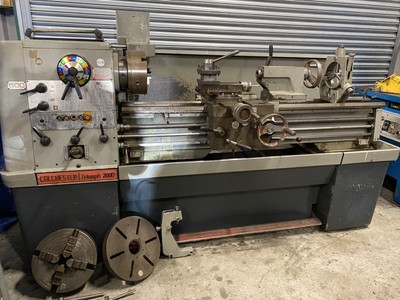
Dean, Smith & Grace 17T toolroom lathe
" Weighing in at 2.5 tons the 17-inch (actual swing 18") DSG 17T Precision lathe was not a modified production lathe, but one specifically designed for toolroom use and built to tolerance and alignments of better than 0.0001". Even today a highly sought-after model, during the 1960s and 1970s they were assembled by a specialist fitter, Tommy Williams - who just loved the work and wanted no other. Fitted with a two-speed 7.5/3.75 hp motor, no fewer then thirty-six forward speeds and twelve reverse spindle speeds were available. Whilst early versions of the 17T had plain spindle bearing, later models were generally fitted with a set of the highest quality Timken taper roller bearings - though the option of a plain bearing headstock continued to be available. Some specials were also built, notably for Rolls Royce, where the headstock was a special, larger casting with a spindle that ran in taper-rollers but also a hand scraped, plain white-metal bearing in front of the front taper-roller bearings. The bearing could take the fitter Donald Booth several days to scrape in (using red lead not "blue" and maintenance engineers report that these lathes never require any headstock work. The bearing was to ensure that, when a test piece was put on the Tallyrond (a machine to test surface finish and absolute roundness) no "bearing marks" were visible. The spindle and its three bearings (the front plain was 4.625 inches in diameter and five inches long) were of massive proportions - with the mandrel bored through to clear a 3.5-inch diameter bar.
Two bed lengths were offered, the shorter admitting 36 inches between centres, the longer 48 inches.
Supplied as standard with the lathe were: a coarse-pitch screwcutting arrangement (a handle on the right-hand side of the saddle allowed an instant reverse) coolant and piping, 4-way toolpost, catchplate, 16-inch diameter faceplate, fixed steady with a 5-inch diameter capacity, No. 4 Morse centres, a drill holder with a No. 4 Morse socket, suds tray, splash-back and a set of spanners.
Optional equipment included a three-point travelling steady, a relieving and taper-turning attachment for the manufacture of cutters, a taper turning attachment (for tapering, not relieving), extra changewheels for inch, mm and other threads, an automatic trip mechanism for the longitudinal carriage feed, a micrometer carriage stop, single and quick-withdraw toolposts - and the usual range of 3 and 4-jaw chucks, collets and steadies. "
so ..... as said "they don't come any better"