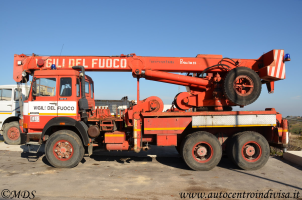
Ing. F. Fiorentini & Co. S.p.A. (or simply Fiorentini S.p.A.) was an Italian company in the earthmoving and construction machinery sector, manufacturer of the first Italian excavator.
Founded in Rome as a simple "Engineering Office" in 1901, by Eng. Filippo Fiorentini, and became S.p.A. in 1919 Fiorentini began its activity of mechanization of construction sites by producing electric winches, concrete mixers, pneumatic hammers, and other construction machinery.
In 1930 it began to produce and sell excavators, bulldozers and mobile cranes under license from American companies, also opening factories in Fabriano, but already in 1936, due to bad relations between the Italian government and that of the United States of America, the supply of components Anglo-American became more difficult.
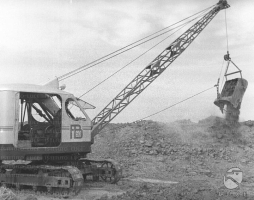
In 1937 the FB 50 came out of the Fabriano factories, the first excavator entirely designed and built in Italy.[2] In the following years, up until its definitive closure in 1975, the Florentine excavators took part in all the great Italian public works.
On 3 March 1944 an Allied bombing hit the Roman establishments in via Tiburtina, located at via delle Cave di Pietralata, killing 117 employees out of the 180 present and Eng. Fiorentini died shortly thereafter of a broken heart[3][4]; he was succeeded by his son Giuseppe. After the war, the company went through a period of revival, mainly thanks to large contracts for the supply of excavators to the USSR. The Roman plants were expanded, transferred after the bombing of 1944 to the current via Filippo Fiorentini (still along the via Tiburtina), and a branch was opened in Toronto, Canada, as well as concessionaires in numerous Asian, African and South American countries.
At the beginning of the 1970s, the conversion of Russian industry from warfare to civilian brought about a drastic drop in requests and in 1967 the heavily indebted company was placed under the control of IMI. Finally, in 1975 in serious financial difficulty, it was acquired by the Società per le Gestioni e Partecipazioni Industriali and closed after a few years.[5]
In the entire period of activity, Fiorentini produced almost 20 excavator models in various versions, and dozens of mobile crane models, as well as a tower crane model, the GT 12/25, and other cranes, bridge cranes, trucks and MTTs of various kinds.
Excavators
Among the excavators were produced in particular:
- FB 50 First excavator (rope) produced entirely by the company and first to be completely designed and built by an Italian company, the first version built had a capacity of 500 liters (the bucket).
- FB 35 Reduced version of FB 50
-FB 80 and FB 120
- FB 200 The largest excavator produced by the company, bucket capacity: 2650 litres.
A worker in front of the FB200. Its considerable size is evident.
Mobile crane
The mobile cranes were initially produced only on tracks on the design of the excavators.
- F54
- F12
- F16
-FB32
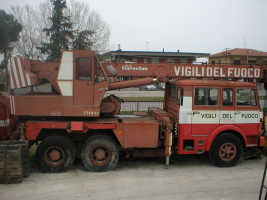
From the 1950s, cranes on trucks also began to be produced
- F500
- F700
- FH30
Curiosity
Mercury mechanical model of the FB35
In July 1948 the company began publishing "il Cantiere", a bimonthly company magazine, with the aim, as well as advertising, of further raising public awareness of the mechanization of construction sites, which at the time saw many tasks still carried out manually, especially outside the big cities. Publication was discontinued in the late sixties.
The abbreviation FB that marked all the models derives from the initials F for Fiorentini and B for Bucyrus International, a US company of which Fiorentini was the representative in Italy at that time. The abbreviation was followed by the number, which, in tens, indicated the liters of capacity of the bucket, for excavators.
The current via Filippo Fiorentini in Rome takes its name from the founder of Fiorentini s.p.a., and housed its main office.
In the 1960s, 1:50 scale models of the excavators were produced. Including radio control, they could move and move the arm and bucket.
Main factory in via Filippo Fiorentini in Rome
State Italy Italy
Corporate form Joint-stock company
Foundation March 10, 1919 in Rome
Founded by Filippo Fiorentini
Closed 1975
Headquarters Rome
Metalworking sector
Products Excavators, mobile cranes.
BAT COSMOTER
excavator
COSMOTER: originally called CoFra (Coelati and Fracca) they began with the production of primordial wheeled excavators (i.e. a 2-axle chassis with a hydraulic loader mounted on top)
then becomes Cosmoter and produces wheeled and tracked excavators...
the models were called BAT... so I wouldn't be surprised if they had something to do with the Metalbat
MessageTitle: Cosmoter cofra industrial machines Icon_minitimeWed Nov 30, 2016 5:31 pm
Cosmoter was an Italian manufacturer of tracked and wheeled excavators from Nogara, Verona, Italy. It was created in 1969 by Cofra and closed in the late 1980s
Bat R Series (Wheel Excavators)
BAT C series (crawler excavators)
Cofra was an Italian manufacturer of wheeled and tracked excavators from Nogara, Verona founded in 1960 owned by Mr.Coelati and Mr.Fracca.
They sold the company to Stegagno, a large Italian trading group in 1969. The name of the new company (company) was Cosmoter
cofra industrial machines Cosmoter%20bat124R-
COSMOTER 20 C
del 1982, peso operativo circa 20.000 kg
COSMOTER BAT ITALIAN EXCAVATOR INDUSTRY HISTORY (1963-1980 CIRCA)
Cosmoter built wheeled excavators distinguished by the initials R (wheels) and C (tracks) with an unusual color
Cosmoter built wheeled excavators distinguished by the initials R (wheels) and C (tracks) with the unusual bright red color of the undercarriage and black arm, an original idea at the time and which will subsequently also be taken up by other earthmoving machinery manufacturers today. In the beginning, that is, in 1960 it was called "Officine Meccaniche CoFra" of Coelati and Fracca, (Nogara VR), it built both diesel and electric tracked and wheeled excavators, in our research we came across the "COFRA cf61" of 1963 but finding photos of these soon proved to be a very difficult undertaking.
In 1969 the company was sold to Stegagno SPA, a large Italian commercial group which, among other things, handled Komatsu distribution on the Italian market, in 1969. Thus the new company was founded which would take the name of Cosmoter and will operate until the late 1980s.
The first series of these excavators mounted a strange extension under the first joint of the arm, similar to a fork as can be seen also from the very rare photos found The Cosmoter Bat excavators by some erroneously defined as batmoter or associated with macmoter, used Perkins, Deutz engines , VM etc. the pumps were the super-tested Linde, not much to say about the reliability of these vehicles; in the Salerno and Potenza area I have often seen many used by woodcutters, in very heavy-duty jobs performed very well and without hesitation despite the many years behind them.
Rebuilding the range of excavators has proved to be an almost impossible undertaking so we will limit ourselves to mentioning the models we know:
BAT 10 C
BAT 14 C (1982) weight 150 quintals deutz 4 cylinder engine
BAT 15 C
BAT 18CL
BAT 20 C
BAT 84c with Deutz F4L912 engine
BAT 94 R
BAT 124 C
BAT 125R with Perkins 4-cyl engine.
BAT 166c with Deutz F6L912 engine
BAT 176c with VM SU105/6 engine
cosmoter excavators vintage Cosmoterbatescavatori
History
Since 1980 we have been manufacturing machines with quality and innovation
Cosmeco is located in Ostiglia, a few kilometers from the cities of Mantua and Verona, in the heart of the Po Valley, crossed by the great river Po and its tributaries. Territory of ancient agricultural tradition, this rich expanse has witnessed over the centuries commendable works of regulation and modeling of the numerous river courses, spraying all the vast cultivated fields that have always characterized this landscape with a dense network of canals. It is in this framework that Costantino Rossi, with already 15 years of experience on his shoulders in the world of agricultural mechanics as a design technician, founded the Cosmeco company in 1980, initially simple metal carpentry which later turned out to be a dynamic and modern artisan reality.
In 1981, in fact, the business began to make its first contribution to the mechanization of the surrounding agriculture, designing and building its first models of rotary ditchers, received with broad consent and appreciation from customers, whose requests became more and more numerous and above all more particular, leading the company to expand its range of products to 50 different models of earthmoving machines. From here it was only a short step to go beyond the Italian borders and enter the international scene, placing the company among the top three manufacturers of ditchers in the world.
In 1984, Cosmeco acquired the agricultural production branch of the Cosmoter company, a company at that time specialized in the construction of ditchers and industrial excavators in general. In the 90s another cornerstone of the Mantua area, horticulture, appears among Cosmeco's projects and prototypes, thus introducing new machines and land preparation techniques. In 1992 the first recognition in this field arrived from the EIMA fair, with an award for technical innovation for the bed former combined with mulch for the cultivation of melons and watermelons. In 1993, on the occasion of FIERAGRICOLA in Verona, Cosmeco won a second gratification with another prize for technical innovation for the large adjustable bed former, for asparagus and strawberries, still available today in 5 different versions.
Cosmeco's road continues towards the 2000s, years in which the company continues to be an interpreter of the evolution of agricultural practice, constantly offering new proposals and customized solutions for the specific needs for local products. Thus was born the adjustable corpritunnel for small tunnels of watermelons and melons, followed by the efficient vertical ditchers for irrigation and drainage, whose success has long equaled that of traditional ditchers. But it was in 2004 that Cosmeco achieved its spearhead with an internal and absolutely exclusive project






 www.facebook.com