things that might make you go WOW!!!!! thread

Bucket on wheels

Bucket on wheels

Well-known member

364017525_10229634405060485_442026733399651084_n.jpg
 
V8Druid

V8Druid

do it as well as you can,but learn to do it better
for those not on FB .. here is the write up accompanying that pic

" A 12-cylinder Nordberg diesel radial engine. This engine displaced 29,556 cu in (484.3 L) and produced around 2,000 hp (1,500 kW). Note the fuel injector in the center of the cylinder head.

The Nordberg radial offered several advantages over the stationary inline engines that were the current standard. With its cylinders horizontal, the Nordberg radial’s output shaft was in a vertical position. Although the engine was built primarily to generate power for the electrolytic reduction of aluminum, its arrangement was perfect for pumping applications. In addition, the configuration of the radial made it more compact and much lighter than a comparative inline engine. The Nordberg radial took up about half the space of an equally powerful inline engine and could be installed on a much lighter foundation.

The Nordberg radial was first introduced in 1947. The first engines were spark-ignition natural gas burning units that quickly established themselves as reliable and economical. These engines had two spark plugs located in the cylinder head. A single cam on the crankshaft actuated a gas valve for each cylinder. This gas valve allowed the natural gas into the incoming scavenging air for the cylinder.

Nordberg continued to develop the radial as its use spread to central power stations and various pumping applications, primarily for flood control and at sewage treatment plants. Nordberg soon developed a diesel version of the engine and a version that could run on a mixture of diesel and natural gas, which Nordberg dubbed Duafuel. The Duafuel engine could run on 100% diesel or as little as 5% diesel and 95% natural gas. This flexibility allowed the engine to operate with the most economical fuel mixture possible. In the diesel and Duafuel engines, the single cam now actuated a fuel pump for each cylinder, and the diesel fuel injector was in the center of the cylinder head. "

and an interesting comment

" Long ago, in the early 1970s, in a place far away, I worked at the Kaiser aluminum plant in Chalmette, Louisiana for 18 months just before they shut it down. Lines 1&2 at the aluminum refinery used Norbergs like this! They ran continuously 24/7/365 and were REALLY quiet. They ALWAYS ran them at 105% capacity! I stood by the cylinder head of one and all you could hear was a muted chuff as it fired. They were on the second floor, and the generators that looked like huge green pears were under each one on the first floor. There was a huge bank of radiators to cool the lubricating oil on the outside of the building. I think we averaged about 1,100,000 pounds of aluminum every day. " :oops: :oops:
 
V8Druid

V8Druid

do it as well as you can,but learn to do it better
probably the reason they were so reliable was that they were so 'under-stressed' - 484.3L producing a mere 2000HP ain't exactly what you'd call working hard :rolleyes: ....
sometimes reliability is far more desirable than wringing the nuts off a motor :giggle:(y)
 
R

Rob65

Well-known member
It's subsea mats is it not, all tied together with a big mesh rope net. They drop them on pipes and stuff to stop them floating away
Yes they are sea bed mats. They are used along the bottom of harbour walls to prevent the sea bed being eroded by prop wash and undermining the quay walls.
 
V8Druid

V8Druid

do it as well as you can,but learn to do it better
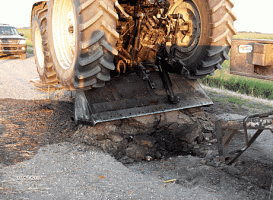
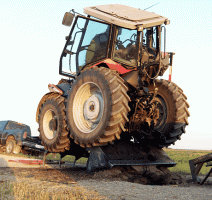
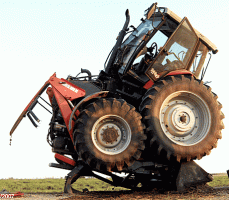
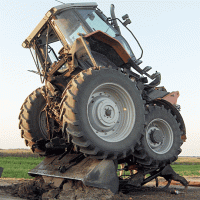
bowling along a dirt road and a hyd failure dropped the loader into the deck :oops::oops: ..... assume the trailer attached stopped it endo-ing ..... might want a couple of gallon of T cut to buff that up
yourfile.gif yourfile2.gif yourfile3.gif yourfile4.gif yourfile5.gif
yourfile6.gif
 
Gecko

Gecko

Well-known member
sfrs4

sfrs4

Well-known member
Top