Dozer hire prices

Bri963

Bri963

Well-known member
Until a few years ago, that was the case, now JD and Liebherr have gone separate ways with the loaders. I've seen the Macmotor machines for sale, don't know anything about them but the 6 tonner looks a useful size.

 
O

Old Operator

Well-known member
I remembered a little trackloader made by Marooka (the tracked carrier people). Rubber track & about 3t. Think the Chinese machines are based on older tech Japanese small stuff. The little Struck machine uses agricultural conveyor chain as a track chain with shoes welded on, earlier machines are here. struckcorp.com/older-products/ They have used belt drive, a diff steer transaxle, hyd drive using a flow divider & speed boost from loader pump, & finally now dual path hystat. Sadly no presence in the UK as nice alternative to a mini for landscaping / garden type work.
 
S

Smiffy

Well-known member
I remembered a little trackloader made by Marooka (the tracked carrier people). Rubber track & about 3t. Think the Chinese machines are based on older tech Japanese small stuff. The little Struck machine uses agricultural conveyor chain as a track chain with shoes welded on, earlier machines are here. struckcorp.com/older-products/ They have used belt drive, a diff steer transaxle, hyd drive using a flow divider & speed boost from loader pump, & finally now dual path hystat. Sadly no presence in the UK as nice alternative to a mini for landscaping / garden type work.

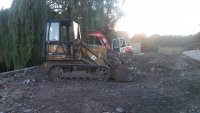
Why not a boxer or vermeer or morbark or bobcat mini track loader as an alternative or even a multione or norcarr or giant or avant arctic steer loader all very good for this application and all easily available in the uk
 
J

Jimoz

Well-known member
There's a drott in old sand and gravel quarry near me. All their material is imported now but they seem to use this for spreading the fill which is being tipped there. I didn't realise they could load till the loader lad wasn't there one day. He tracked down and filled me up
 
Grahams

Grahams

Don't complain - suggest what's better
I know Norcar do hire machines, even the tracked version. Andy is very helpful. You can ring him on 07867426919.
Graham
 
O

Old Operator

Well-known member
I did once talk to the then Boxer dealer, looking at a fixed width 427 (42 ins wide). The engine was fine for up to 25 degrees slope, but Boxer recommended a much lesser slope for the machine. There was the added hassle of having either a bucket or backhoe on at any one time. I gather the later 525 model has 'engineering design issues' in so far as it will not stay put on anything of an up & down slope. The Struck hydro (gear pumps on previous model) is a mature proven system with both overpressure & anti vacuum valves for each drive motor, & also a manual multidisc foot brake for emergencies & parking. Boxers are very fast considering you only have a plate to stand on
 
O

Old Operator

Well-known member
I got interested in the CTL vs old Drott thing, Did this paper comparison taking an IH B100 & the Eurocomach ETL 160 as they both have an option of steel tracks.
The B100 drawbar pull divided by bucket width is 144 Lb per inch of width. The Eurocomach manages 114 Lb per inch of bucket width.
In both cases I checked the claimed DB pull was not more than 90% of the unit's all up weight & corrected to this if needed. Any fig above this is taken with pegged tracks, as the 90% real world fig is a tracked vehicle on dry clay.
Dressta claim a DB pull of 1.5 times all up weight on their TD8 - no doubt with pegged tracks & the hystats swashed right back to barely moving - just means that the real world pull occurs at a higher speed
The CTL comes out as less good than the Drott but as good as its BTD6 dozer sister version with the blade set square, also the D4C of that era
Going back to the original question of tracks pushing on a concrete surface, well the steels have only a 45% rating where rubber wheels would have about 90% on a clean dry concrete surface, not sure how rubber tracks play out, BUT the surface is not clean, being dusted with fines from the material being pushed. At least the rubber tracks will not puncture
 
M

muckyman

Active member
Forget working out figures on paper , tracks beat tyres even on concrete spent most of my life driving tracked loaders a lot as to do with weight of the loader theres so many variables if it gets hard going you don't use full width of the bucket 20180907_192844.jpg
 
Bri963

Bri963

Well-known member
How do tracks beat tyres on concrete? If it's rough concrete you knock the machine to bits, and if it's smooth you slide and you still shake up the machine. At least in my limited experience.

One issue between rubber tracked CTL's and the old Drotts is build quality and basic design. On paper a modern 5.2 tonne Cat 299 with over 100 horses and hystat should pee all over a 40 year old power shift drott with about 80 nags. However, when you look at the loader geometry the CTL's are designed for speed, not breakout force. They are more of a tool carrier than a flat-out muck shifting tool, and a huge compromise. I've spent a good few shifts on several Cat CTL's and MTL's and they're woefully short of breakout force. Picking up and spreading loose material they're good, and easy to grade with, but digging into anything compacted, forget it. The amount of flex in the arms is frightening.

I've often thought that a 299 driveline in a 100B frame would be a fantastic bit of kit. The old drott loader design was way ahead of anything else and for a long time. Look at a 953, 963, 973 and the geometry is the same, just that the 53 and 63's have one tilt ram instead of two.
 
O

Old Operator

Well-known member
Regarding the OP problem it seems that we need a wheeled loader for the concrete but not the punctures the material to be moved will cause. Something like this tyre maybe solidcushiontires.com/flat-proof-tires/ or similar? Got the idea from foundry / steelworks solid tyres.

I was asked by a friend to come up with a single machine to level a moonscape of craters caused by long collapsed limestone workings- overgrown by trees (some of which must stay) & also some topsoil to be recovered & stockpiled where poss. Steepish access to the job demands tracks. I looked at everything but could never better the idea of a drott as a single machine with a single operator to pay for.
A small dozer could have done some but the clam tackle so much more. Trouble is even if a low hrs unit with goodish track life left found (e.g. ex army reserve), so many are now orphan makes with no spares available. Komatsu I am told keep spares for 10 years after the last model left the production line (OK there are some Indian aftermarket spares) Case & Komatsu made their last drott about 1993, Fiatallis (no longer existing?) made their last about 2002.
I know there are the the Deere/ Liebherr machines & the 953 etc but these are big & expensive beasts.
If anything the now defunct front engine Cat 931, 933, 935, 939 might fit the bill. Many parts are common to the equivalent D3 & D4 of the time & Cat have a reputation for offering parts up to 50 years after the last one made - (if at a price) & there are aftermarket parts. Some were direct drive, some 3F 3R Powershift, some 3F 1R Powershift, & some (933 & 939C) carried on into the hystat era till about 2012. In terms of repairs which transmission system is the most trouble free??
I would have said direct drive but well remember the torque models did not tend to get the 'back end' final drive troubles that the B100's did. Not sure if the Cat wet main clutch was a softer start helping in this area? The hystats I do not know - but imagine this system eliminates steering clutch & brake band troubles, always a bugbear on crawlers.
Re the modern drive in a 100B frame I see what you mean, the IH patent Z bar crowd linkage (case had a work around but not so good). Otherwise the last 933 etc & Macmoter were somewhat in this way but without the Z bar. The 3CX sort of had it (once out of patent) & the Bristol / Track Marshall - earlier so must have paid royalties to IH. I do feel like some kind of 'steam nerd' advocating a small drott when no one else seems to want them. Gather that the last few Case ever made were hystat, I cannot see why anyone making a small dozer could not offer one if the Cat small hystat thing basing them on the D3 tractor is true.
 
doobin

doobin

Well-known member
I was asked by a friend to come up with a single machine to level a moonscape of craters caused by long collapsed limestone workings- overgrown by trees (some of which must stay) & also some topsoil to be recovered & stockpiled where poss. Steepish access to the job demands tracks. I looked at everything but could never better the idea of a drott as a single machine with a single operator to pay for.

360 of suitable size with a grab and land rake. Sorted. Modern kit, plenty of drivers available and very versatile.
 
Bri963

Bri963

Well-known member
939's were made after the 943 was continued, say up to around 15 years ago, but there were never many over here. If you find one parts are still plentiful. I know it's fashionable among us old farts to say the clutch/gearbox machines or the power shift machines were the best but you have so much controllability with a hystat, especially on bad ground like it sounds your friend has.
 
O

Old Operator

Well-known member
Problem with the 360 is that it cannot doze forward & cut down into the large cone shaped craters. I can see how a 360 teamed with two dumpers & a small dozer could well undertake the job.BUT 'authority' demands that it is done over an extended period in areas to allow wildlife to re establish & sort of migrate from the unimproved to the improved. In other words it cannot be hit all in one, the nature people have a big say over the council. This is sort of why it has not been done as yet. He really wanted to own one machine & tackle it a bit at a time as funds & time allow (This is not the extreme slopes job I was once asked to tackle)

I was more wondering about the hystats vs the other two as to reliability & low maintenance of the system. Tarmac ran 943's & had no trouble whatsoever but had a buy new & 3 yr replacement programme. I got to play on a 943 for a morning but had to go back to my own mount. Found the hystat a godsend compared to say a manual 951 or D4 - but that is the limit of my experience of them in the seat
On the subject of tracks I seem to remember that if you had pins & bushes pressed out & turned 180 degrees in the track chains you did this at 1500 hrs, if you did not opt for this action, the chain life was about 2000 hrs from new, but the turning gave you a second life of 1500 hrs on top of the pre turn 1500 hrs? I cannot remember if the rear drive sprockets were renewed at the turning of the pins / bushes. The act of turning could only be done on a specialist track press & meant the pre removal of the shoes? I think it was price x if they removed the shoes & price y if they took the chains away shoeless.
This was pre SALT tracks, I did pick up that SALT chains would be best turned at 2000 hrs, then there is the option of turning the pins/bushes either wet or dry (i.e. to re lubricate & re seal the pins on turning 180 or not - the economics of the wet/dry choice being very finely balanced. I must add that we are in a clay area here, as this was thought to lubricate tracks?

Are SALT chains made by Cat or bought in as original equipment from Berco? I do know there was a time when Berco stopped making 6 inch pitch chain of any type, but later re started. I think there was once an Italian maker of replacement track parts? Mario De Malo??? Sorry about all this but it was all a long time ago when I worked on re tracking. IH & Case were non SALT, we used I think either Saville or Strickland for the press out & turn, was pre 1983.
 
doobin

doobin

Well-known member
A 13 tonner with a blade would do the job fine.

I don't reckon your mates ever going to do this job. Sounds like he wants someone to tell him 'yes, this old machine for just £8k will do everything you need and more'. Um, no. Commerical realities apply. With a 13 tonne, blade, land rake and grab I'd have done the job in the time that's been spent pontificating. :ROFLMAO:
 
Bri963

Bri963

Well-known member
With a bit more background knowledge, to me it sounds like you'd be as well buying/hiring a dozer. Bit more sure footed on slopes. Don't worry too much about the reliability of hystats, if you buy a good one and maintain it, they stay good for a good few thousand hours. I'd like to see a 13 ton excavator with a blade working slopes just for amusement value. Might be easier to get one and an operator, but best machine for the job? I'd want to see the job first.
 
Last edited:
Scoff

Scoff

Member
Anyone know any up to date prices for hire,looking for a 13t size machine on lgp tracks.
 
Top