
Batteries 😶😶

Gecko

Gecko

Well-known member
The boat is moored in the water and wind and passing vessels move the boat a few times a day. The electrolyte in the batteries is stirred gently and it's sulfuric acid concentration remains even top to bottom as it happen in a car, or machine that moves around
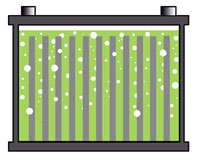
The generator is obviously static and the batteries are sitting on the concrete floor. The acid molecules are heavier than water and go slowly to the bottom, and the top of the plates in the cell sit in almost pure water.
An interesting observation, but it might have more to do with keeping the plates free of debris rather than a concentration gradient of the acid.
When mixed with water, the concept of "acid molecule" doesn't have meaning.
HCl + H2O becomes H⁺ Cl⁻ or H₃O⁺ Cl⁻
2 H2SO4 ⇌ H3SO⁺4 + HSO⁻4
We can easily test for density gradient using a common Hydrometer taking samples from the top and bottom of the cell.

We can also demonstrate that ultra fine clays form a colloid in water where the partials are held in suspension and never settle out. These particles are vastly larger than acid ions.

Someone told me that concrete kills a battery sitting on it.
In fact a colder environment like sitting on concrete will make a battery last longer then in a hot environment.
I've heard this too, but the explanation is unclear.
I've assumed it's to do with having a temp gradient in the battery with the acid being more concentrated (higher density) at lower temp.
Until I see a better explanation, I space my batteries off the concrete on strips of timber to allow air flow.
 
Last edited:
T

Tacitus

Active member
My use of the term molecule is perfectly valid. Yes in solution the sulfuric acid molecule (no Chloric acid in batteries) ionises, but Sulfuric acid is always ionised even in high concentration, so the use of the term molecule is generic and not academic.
I don't think you can compare ionic solutions with colloids, they behave different even when they are often confused.
As for the stratification of the acid solution in batteries, see below article.
I am not sure that the observed difference in the life of the boat batteries and the generator batteries can be attributed to movement that reduces stratification but is is my educated ... guess that can be just as easily wrong.

 
Gecko

Gecko

Well-known member
(no Chloric acid in batteries)
errr ... good call
I don't think you can compare ionic solutions with colloids, they behave different even when they are often confused.
I wasn't confusing them, I was using a colloid as a comparison because they are different. Colloids are formed with partials orders of magnitude larger than molecules.

I have a medium size diesel generator for emergency, that gets used once a month if that, yet the battery is connected to a solar panel and is always fully charged.
Your link above (an interesting read) suggests keeping the battery fully charged will prevent stratification eg. your genset on solar. Given I do the same thing, I'm wondering what sort of regulator you've chosen?
My understanding is keeping a lead acid battery fully charged also isn't the best for its life expectancy, so I make use of the inbuilt timers and run a load each night to take top off.
 
Last edited:
T

Tacitus

Active member
The solar panel for the genset is a small one, from memory under 10 A/H and I added an ordinary solar panel regulator.I believe it was a bit bigger, 15A.
You are right in saying that keeping the battery 100% all the time is not ideal, however with solar. for obvious reasons there is no risk of that, with nights and overcast days allowing for some self discharge. There is no easy way to keep a battery healthy when not in use regularly. The battery that surprises me the most is the little one in my ride on mower. I use it for an hour or so every week in summer and once a month i winter, and only hook it up to a smart charger once in a blue moon. Yet it keeps on going, in its 11th year.. (y)
 
Gecko

Gecko

Well-known member
I think it was one similar to this one. No not 10W that would be puny :giggle:
Yeah 10W is small, but it's actually quite enough to keep a battery topped up if it's only self discharge its fighting against.
 
Top