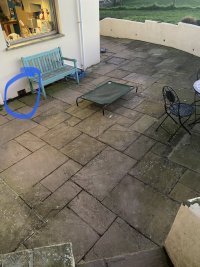
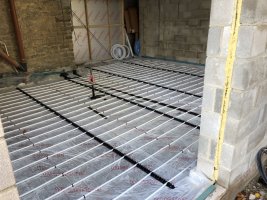
Patio @ dpc level

Danny

Danny

Well-known member
Went to look at this job the other night customer has lived there for 6 years and has started to notice damp coming through on the walls, you cant see it in the picture very clearly there is a aco drain along the wall but its still @ dpc / airbrick level.

The only solution I can think of is to rip the lot out and lower at least 150mm below the air vent

Any other ideas before i tell them the bad news?
 

Attachments

  • IMG_5517.jpg
    IMG_5517.jpg
    232.5 KB · Views: 634
  • IMG_5520.JPG
    IMG_5520.JPG
    236.5 KB · Views: 585
V8Druid

V8Druid

do it as well as you can,but learn to do it better
Went to look at this job the other night customer has lived there for 6 years and has started to notice damp coming through on the walls, you cant see it in the picture very clearly there is a aco drain along the wall but its still @ dpc / airbrick level.

The only solution I can think of is to rip the lot out and lower at least 150mm below the air vent

Any other ideas before i tell them the bad news?
do my eyes deceive or is it falling toward the house also ?? ..... can't see much else you could do with that really:unsure::(
 
F

fred

Well-known member
yup JD has it. We allways put a vertical DPC tray on the new builds to facilitate level threshold with FFL and outside as its what people want.
 
O

OBL

Well-known member
yup JD has it. We allways put a vertical DPC tray on the new builds to facilitate level threshold with FFL and outside as its what people want.
This... cavity tray to protect inner skin from damp releasing any water that gets behind outer skin through weep holes... I have also sometimes seen a second dpc 150mm above.

The paving above probably would be ok with standard cavity wall if it was built right. Only problem the bricks above the paving would now be normal housebricks laid with a weak mix not engineering bricks laid with strong 3-1 mix so susceptible to saturation and frost damage from rain splash.

Obviously if solid walls as I’m assuming above it’s not a great idea... But could be far less of a risk if detailed correctly.

I’d be checking the channel drain installation first, if it is butted against the house it’s likely no concrete/mortar is between brickwork and drain channel. You could lap a wide dpc in an L under the channel and concrete bed and up the wall before setting the channels. They don’t seal together well and water tends to sit in them once crap builds up possibly leaking and pooling against the wall before it gets to the outlet.

I’ve seen some shocking jobs, channels set on spots, slot drains with no access, channels roughly mitred in corners and barely connected.
Takes time and patience to get them right.

If paving has to fall back to the house then I usually lay one row of paving falling away from the house say 600mm then instal slot drain then paving falling back to house. Makes life far easier getting drains in if the house was trench fill...

 
F

fred

Well-known member
also with block and beam the vents help the patio drain when needed, an unintended design feature!

@hiluxman man With celotex prices going through the roof we have switched to 150mm EPS for floor/slab insulation as its half the price for same U value. It has the added benefit of working brick which celotex doesn't which simplifies buildup. it also burns much easier for offcut disposal!!
 
doobin

doobin

Well-known member
also with block and beam the vents help the patio drain when needed, an unintended design feature!

@hiluxman man With celotex prices going through the roof we have switched to 150mm EPS for floor/slab insulation as its half the price for same U value. It has the added benefit of working brick which celotex doesn't which simplifies buildup. it also burns much easier for offcut disposal!!
The U value of celotex drops to similar to EPS after something like five-ten years anyhow!! So you're almost better going for thicker EPS to start with.
 
O

OBL

Well-known member
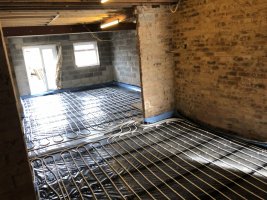
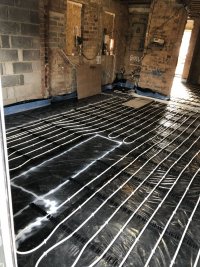
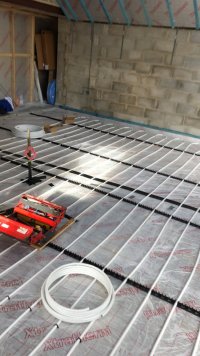
100mm of polystyrene topped with 50mm of celotex as the foil board holds the underfloor pipe clips far better than polystyrene if screeding.
 
GazCro

GazCro

Well-known member
The U value of celotex drops to similar to EPS after something like five-ten years anyhow!! So you're almost better going for thicker EPS to start with.
Why does the u value drop then?
 
GazCro

GazCro

Well-known member
breaks down and goes powdery after a while doesn't it? :unsure:
Dunno I'd have thought it would last forever sealed in under floor slab. I know with underfloor ur meant to visqueen over it before clipping pipes down but i thought that was more to do with air bubbles coming through and spoiling floor finish. Tbh I'm sure i was told over 100mm in a floor the benefits are so slight it's almost worth not bothering.
 
pettsy

pettsy

Well-known member
Dunno I'd have thought it would last forever sealed in under floor slab. I know with underfloor ur meant to visqueen over it before clipping pipes down but i thought that was more to do with air bubbles coming through and spoiling floor finish. Tbh I'm sure i was told over 100mm in a floor the benefits are so slight it's almost worth not bothering.

I’m told with liquid screed, it’s because the screed attacks the foil on the insulation. I wonder if it’s sunlight that makes it go powdery?
 
Shovelhands

Shovelhands

Well-known member
I’ve been told to put a slip membrane, basically thin plastic sheeting, over the insulation before clipping the pipes down. Due to the screed eating the foil on the board.
But there must be lots of places laid without it!
 
GazCro

GazCro

Well-known member
I’m told with liquid screed, it’s because the screed attacks the foil on the insulation. I wonder if it’s sunlight that makes it go powdery?
Could be the only times I've seen it go powdery it's been lying about outside a long time. I guess once built in it shouldn't be an issue though. I know any floors I've taken up the foil comes with the conc but tbh its still intact stuck to the conc.
 
F

fred

Well-known member
its something to do with the gas that makes it degrading over time, apparently the U value stated for it is good for 25 years!
 
F

fred

Well-known member
we tend to put the dpm under the insulation but then we dont use liquid screed.
 
Top