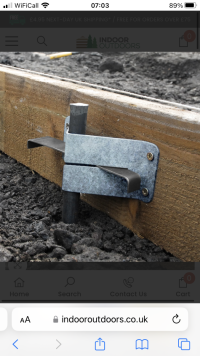
I've got a crate full of those metal clips for wood. They're OK-ish, but the pin supplied are nowhere near long enough. Even if you buy longer, they will wobble about due to much less surface area than a wooden post. I also don't trust them with a beam tamper, they are liable to continue driving into the ground. Basically you've never got exactly the right steel pin that can be driven in deep enough to hold well but not stick up proud.
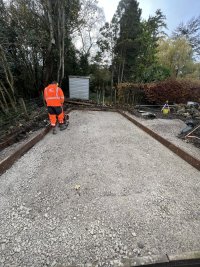
I find it far easier even for large-ish jobs to drive cheap 3-4" wooden posts in with the handheld hydraulic hammer, and screw through to them. Then cut flush with a chainsaw. For what I presume you are doing (small concrete bases for boilers and plumbing stuff?), I prefer to cut the form to size, kit form, from 6x2 or similar (love having my own sawmill) in the comfort of the workshop. Much more pleasant to measure, cut dead square on a chop saw, can even chamfer the edges.
Take it to site, screw it together, spray round it, excavate. The a few site pegs bashed in every metre around the edge and a clubhammer or sledge. Set level with screws using the NivComp to measure- no messing about. Easily attain a tolerance of a couple of mil.
Road forms are ideal if you do a lot of long, uniform concreting such as farm tracks, but a hassle to store and keep clean, plus for odd jobs you never have the right lengths and are loathe to cut them down. Timber can often be re-used and I find it a lot quicker to work with on most jobs. When I got the sawmill the decision became super easy- the last length off the mill is always an odd thickness that you can't use on the cutting job in hand. But thickness doesn't matter for formwork. So stick them to one side, and last thing put them all back on the mill at once and cut them to a uniform width. Stick em on the shelf, jobs a good un.