JS150LC track gearbox gear damage

O

oldchips

Member
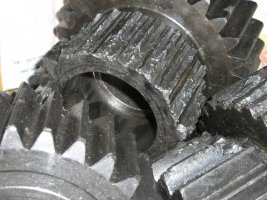
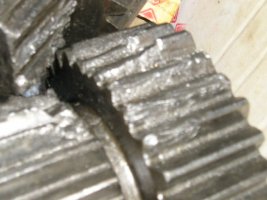
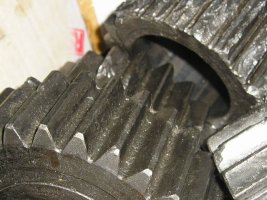
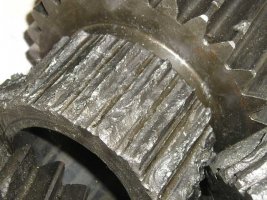
Finally tried to repair my JS150 track gearbox after 6 months of hospitals and then 2.1/2 years of Covid.

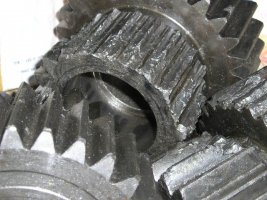
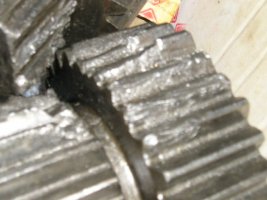
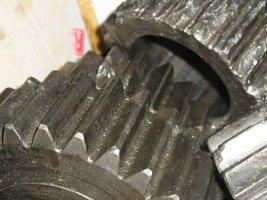
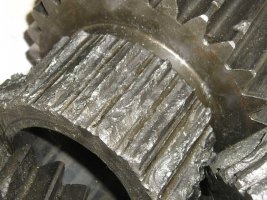
Look at the photos for the state of the reduction gears, and the central roller bearings weren't any better. Strangely the outer ring gears were chewed but not terminally so.

Why in this state? The machine was a scrap handler, and my thoughts are that it was never tracked, so no oil spread on the gears and bearings, so years of dry movement slowly scraped the gears into steel dust. The inside of the gearbox was covered in little pieces of steel and dust, the oil had been long overheated and ruined. When I bought the machine the oil was black and stank to high heaven, obviously changed, but just as bad in only a few 10's of hours of use, much of it moving. So, when buying a machine undo the various level plugs and if the smell doesn't hit you, get a length of wire to poke inside and look at the oil. If it stinks, or none, then go and find another machine to buy!

I bought just the three dual gears, cost about £900. For £1400 I could have had a complete gearbox but in the end decided I couldn't cope with the weight of the gearbox, plus the problem of splitting the track. It was a sensible decision but now regret it.

The problem was that machining up some new phosphor bronze bushes to replace the roller bearings was easy, it was the weight of the complete unit plus the setting of the gears in the correct position that proved impossible. As you would expect the three gears need to fit into the two ring gears, and with different sizes of all gears then there might be only one possible way they would fit. The gears are marked with two marks either side of one tooth. The central drive gear was also marked with three marks, but these were on the inside of the gear, not visible when trying to assemble. I didn't have the manual to hand so had to guess, wrongly, how the three gears were aligned. Being wrong didn't really stop the fitting of the planet carrier into the hub, the shear weight of it effectively did that. The manual shows the assembly process with the hub off the machine, with the opening upwards, and a crane lowing the carrier into the hub. None of these were possible stuck out in a wood. Future attempts will need a circular clamp around the carrier with some lifting gear to lower it into the hub.

The next problem is that with the new gears and bearings, there isn't any real clearance between gear teeth to slide the carrier into the ring gears. Not like when it was dismantled when the wear meant there was inches of clearance!

The moral of the story is that even something as tough as a digger can be easily wrecked, know how to check before purchase! The machine is good, no leaks, pins tight, engine runs fine, changed various oils, tracks and sprockets loads of life, slew ring tight, just needs two powered tracks to move around.
 

Attachments

  • P1010004.JPG
    P1010004.JPG
    66 KB · Views: 152
  • P1010005.JPG
    P1010005.JPG
    77.3 KB · Views: 140
  • P1010006.JPG
    P1010006.JPG
    61.8 KB · Views: 146
  • P1010007.JPG
    P1010007.JPG
    75.2 KB · Views: 153
craig

craig

Well-known member
Make you wonder if maybe it`s been a long standing problem, with manufacturing or heat treating :unsure:
 
V8Druid

V8Druid

do it as well as you can,but learn to do it better
struggling to comprehend why a set of planetary drive gears'd be 'timed', when you consider the number of revolutions each gear would do in a few revolutions of the reduced hub ?????:unsure::unsure:o_O
 
Bri963

Bri963

Well-known member
They’re not likely to be timing marks on an epicyclic train. What state are the ring gears in? If the planetary gears are that bad it’ll be a surprise if they haven’t taken a hit.
 
Last edited:
O

oldchips

Member
It is operator error. My local scrappy uses two PC150 machines and they get no tracking, just sit in one place all the time. Did tell them my woes and said that they change the oil every year, but the tracks are seizing up.

You will get the same problem with four wheel drive vehicles. Had a series Land Rover and when took the front hub out to try and make it a little more oil tight you could see the rust line above the oil level in the axle. This is why I always drive slowly, 10-15mph, when first setting off in my Range Rover, just to get the oil moving in the hubs and axles, not used sometimes for several weeks.

The problem with the timing marks is that with the two speed drive you have two ring gears so each of the planetary gears need to mesh into both ring gears. Because the planetary gears have different numbers of teeth at each end then the tooth spacing varies all the way around the gears. Then when dropping the gears into the ring gears it is easy to get the first gear to mesh but the tooth spacing on the other gear is then random. You need the timing marks to match the tooth to tooth positioning of the planetary gears so that the other ring gear will also mesh. Can do it by trial and error, but get it wrong and meshing is too tight then gears won't last very long. If you have just a single speed hub then problem goes away, don't have to match the two sets of gear speeds, just one set.

The ring gears had the odd chipped tooth, but more than enough of the gear teeth to work happily, besides which, I will be driving it carefully.

I still think that the whole problem starts with the lack of oil in the central gear roller bearings. These are built up out of a cage and rollers running on the central pin, 40mm diameter, and inner bore of planetary gear, 60mm. With the desired oil level that is only halfway up the enclosure, so at least one planetary gear will be above the oil level. Start to move, scrape scrape inside the top gear. Yes, it is a roller bearing but machine had done 5,000 hours so only needs to be a little scrape every time. As soon as some metal is scraped off the pin, gear or rollers then that wears the rest of it. If the oil is regularly replaced then that should take the debris out, but who runs the machine until it is warm before changing? No one. The 40mm pin had worn areas that could be felt by the finger nail, the rollers in the bearing where 1mm or more undersize. It can only have been 30-40 hours of tracking work from me replacing the oil when bought to the failure of the gearbox.

Thinking about this, might be better to simply turn it into a single speed machine, not in that much of a rush. Would need to remove the inner ring gear, or cut the inner gear teeth off the planetary gears. Can't remember how the two speed works, manual not in front of me, but think the inner ring is clamped by the hydraulic cylinder to stop it rotating.
 
JD450A

JD450A

Feral as Fk 🐾
Track motor final drives are often timed on the larger machines. Hyundais in particular self destruct if put together wrong.
 
Bri963

Bri963

Well-known member
It is operator error. My local scrappy uses two PC150 machines and they get no tracking, just sit in one place all the time. Did tell them my woes and said that they change the oil every year, but the tracks are seizing up.

You will get the same problem with four wheel drive vehicles. Had a series Land Rover and when took the front hub out to try and make it a little more oil tight you could see the rust line above the oil level in the axle. This is why I always drive slowly, 10-15mph, when first setting off in my Range Rover, just to get the oil moving in the hubs and axles, not used sometimes for several weeks.

The problem with the timing marks is that with the two speed drive you have two ring gears so each of the planetary gears need to mesh into both ring gears. Because the planetary gears have different numbers of teeth at each end then the tooth spacing varies all the way around the gears. Then when dropping the gears into the ring gears it is easy to get the first gear to mesh but the tooth spacing on the other gear is then random. You need the timing marks to match the tooth to tooth positioning of the planetary gears so that the other ring gear will also mesh. Can do it by trial and error, but get it wrong and meshing is too tight then gears won't last very long. If you have just a single speed hub then problem goes away, don't have to match the two sets of gear speeds, just one set.

The ring gears had the odd chipped tooth, but more than enough of the gear teeth to work happily, besides which, I will be driving it carefully.

I still think that the whole problem starts with the lack of oil in the central gear roller bearings. These are built up out of a cage and rollers running on the central pin, 40mm diameter, and inner bore of planetary gear, 60mm. With the desired oil level that is only halfway up the enclosure, so at least one planetary gear will be above the oil level. Start to move, scrape scrape inside the top gear. Yes, it is a roller bearing but machine had done 5,000 hours so only needs to be a little scrape every time. As soon as some metal is scraped off the pin, gear or rollers then that wears the rest of it. If the oil is regularly replaced then that should take the debris out, but who runs the machine until it is warm before changing? No one. The 40mm pin had worn areas that could be felt by the finger nail, the rollers in the bearing where 1mm or more undersize. It can only have been 30-40 hours of tracking work from me replacing the oil when bought to the failure of the gearbox.

Thinking about this, might be better to simply turn it into a single speed machine, not in that much of a rush. Would need to remove the inner ring gear, or cut the inner gear teeth off the planetary gears. Can't remember how the two speed works, manual not in front of me, but think the inner ring is clamped by the hydraulic cylinder to stop it rotating.
Two sets of ring gears doesn’t mean it’s a two speed gearbox. In the mid-range Cats there are two ring gears machined into the housing, but no physical gear changing. Two speed is done by changing the max. Angle of the swashplate. Might be different on a JS.

Re timing epicyclic gears, first time I’ve heard this one, but then there’s a lot I haven’t heard of. I know with Cat finals you can have a fight getting everything lined up in both sets, but there are no timing marks. Be interesting to hear what Mick or Gus have to say.
 
Last edited:
O

oldchips

Member
Well, some action if not progress.

Did try to reassemble the gears, found the alignment marks, and also found the relevant picture in the manual. It is not obvious, with hindsight shouldn't have expected it to be with planet gears with different numbers of teeth.

In any case, it was impossible to lift the cluster and slide it into the ring gears, far too heavy. Also the new gears have minimal slack and clearance, unlike the ones that came out! The manual says to install the cluster vertically, can then rotate bits and wiggle them enough to slide in. This is stupid, have to remove the whole assembly in order to fit it! Trying to think of a way to hang the cluster from a chain so can wiggle it into the ring.

Just to keep you all amused here are the photos of the cluster gears, the damage is rather apparent.

The whole lot needs to be reassembled, can't just run on a single speed because the two planetary gear sets work as a pair. The inner ring gear is either braked or free to get the two speeds. I think the whole design is crap. Whilst yes, it is all nice and compact, it is also very expensive to make compared to the simple gear train as used on my old Akermann. Also the use of swash plate motors is silly, a simple gear motor is perfectly usable, lets face it, you either want to move or not, fine control isn't that important at 1.2mph.

So the digger is still stationary, and I really have had enough of it.
 

Attachments

  • P1010004.JPG
    P1010004.JPG
    66 KB · Views: 122
  • P1010005.JPG
    P1010005.JPG
    77.3 KB · Views: 140
  • P1010006.JPG
    P1010006.JPG
    61.8 KB · Views: 142
  • P1010007.JPG
    P1010007.JPG
    75.2 KB · Views: 143
Mick-the-fitter

Mick-the-fitter

It’s what I do!
Two speed is done on the plate angle in the motor I’m sure, the double gearing in the hubs is just double reduction!
 
O

oldchips

Member
Wouldn't argue, looking at the drawing of the gearbox in the manual and the speed change hydraulic feed does go around to the swash plate. But then it makes you wonder why it just isn't a variable control for the track motors? Always seemed sensible to have a mechanical speed change just to get the advantage of a mechanical gear reduction to increase the available force.

Over complicated, and a lot to be said for an old Hymek!
 
V8Druid

V8Druid

do it as well as you can,but learn to do it better
Two speed is done on the plate angle in the motor I’m sure, the double gearing in the hubs is just double reduction!
can well believe that ... had a two speed hoist on my 30t Demag and that had a piston motor driving it with several lines to it
 
Top