Thanks, it later crossed my mind that adding a glazed cab to such a small machine only made it all the more top heavy. Also it has a chassis mounted 'motorisation castor' that in effect makes it a 'tricycle' when motoring along (Perhaps inspired by the Poclain TY45?) On some other makes these castors mounted on the dipper in place of the bucket. - this meant fewer hoses through the union & steering accomplished by slewing a little. The Powerfab early castor had no inbuilt fail safe brake, & could 'run away' in some circumstances. I think the castor only adds to operating difficulties on one of these. It may have had it's place on the flat land 360W they did. More practical was a slot in 'site towbar' meaning the machine could be towed at low speeds by a tractor or dumper on flat land. Batemag told me that for every spider there were about 1000 tracked 360's made. An offshoot company used to fully rebuild the older simpler Kamo Junior & 3X machines for about 10, 000 Euro.
I never tried to walk the Kamo over an obstacle, I did quite a bit of sidehill trenching with it though. I had driven a Smalley 5 before, the Smalley could not so easily work sidehill as the Kamo could.
There was later a 'Menzi Master 515' - this took a different approach - having adjustable gauge track frames & an engine that would not seize in any plane up to the max slope it was designed for, a low profile boom & dipper with extendahoe. This could handle slopes (less than a spider) but could still do conventional work efficiently. I did look into making a mini version of this from a French Kit & selected an engine good for up to 25 deg in all planes. They suggested a permanently wide gauge (though they were perfecting expanding tracks.) The difficulty came in that they had no brakes beyond the oil trapped behind a ram type spool. I looked into adding these from Lossi, but it meant modified travel spools for them to operate.
I gave it all up - My dad is 93, lives in two rooms of a rambling old place set in half an acre of steeply sloping garden with hedges on top of tall retaining walls. He no longer drives & never had the internet. My wife has been ill several times - at the moment a trapped leg nerve. This means the allotment also totally fell to me. She does not drive, neither does her son. Add to this providing winter wood to two stoves.
Good point I have a little 'brick arch' workshop with 16A welding socket there & no too near neighbours to annoy with noise / welding interference. All this is why I am not on here as often as I used to be
I am though still working on the 5 star Gopher, got teeth cut on a gear blank I turned to get the big old lathe going in low range again. This allowed me to bore 3'' holes in 20mm thick plate. With help from an owner in France got measurements for a kingpost that was missing, made a wooden mock up to prove these were OK. Transferred all this to metal, tacked up to further prove the geometry. There was a 'crescent moon' wear groove in the fixed chassis turntable, we decided it better to build this back up rather than disturb the chassis structure. This I have done using the 'bead pad' technique taught on welding courses. I removed the engine's ignition system to be on the safe side before this. Also a stud had been ripped out of the fan cowl during it scraping against a low branch I was told. Made a repair plate for this & got it mig tacked in, drilled & tapped same. All back together & engine running with a clone pull start now covering the dangerous open starter wheel. Need E7018 root runs to fully weld the kingpost - R Tech inverter should arrive tomorrow for this. Druid you may remember me asking about this vs. an Oxford old oil cooled unit. Also you kindly directed me to Mig Welding Forum, they have been a great help, there are some pics of the lathe repair job on there! Went for the Inverter as the current needed to run the Oxford meant a 32A socket. Am told the inverter will turn down low enough to even run 1.6 rods if ever needed
BTW David John designed a tiny machine called the Powerfab 007 - this was toward the end of the company, It was re hashed by his son Nathan, not a bad machine BUT it is jittery in the slew area because of direct drive. The best version was built by Essex blacksmith Dan Tester, he used a gear reduction in the slew. It was on Youtube but has sadly disappeared

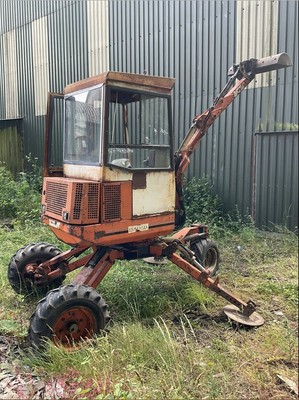 Located Oswestry Shrops, A couple of caveats though - it has swamp pads rather than 'dry land' feet - indicating it has been used in boggy wet ground, has the slew ring been under water? It would have a 10 port rotary union - not cheap if needing replacement. Could be a start for anyone wishing to get into this area? I would have been interested myself but the job I wanted one for evaporated, my 93 yr old dad takes more of my time now, & I am deeply into restoring another mini machine - more on this soon in the classic section.


