
Track tension ajustment problem -JCB mini digger

Goodwill Man

Goodwill Man

Member
Hello everyone,
I'm reaching out for some advice. Recently, one of the tracks on my JCB mini digger came loose. On this model, track tension is adjusted with a large bolt (30mm socket). On one side, the bolt adjusts smoothly, allowing me to turn it in and out as needed. However, on the other side, turning the bolt is extremely difficult.
I managed to turn it one full rotation out (to loosen) and then back in by roughly the same amount, but it won’t turn any further. I’ve applied DW40 to the bolt, but it’s still stuck. Currently, the bolt on one side is out by about 55mm, while on the problematic side, it’s extended to about 65mm and won’t go any further in.
Could this issue be due to severe rust? If so, what would be the best solution to adjust the tension? I’d really appreciate any tips or advice from those who have dealt with similar problems.
Thank you!
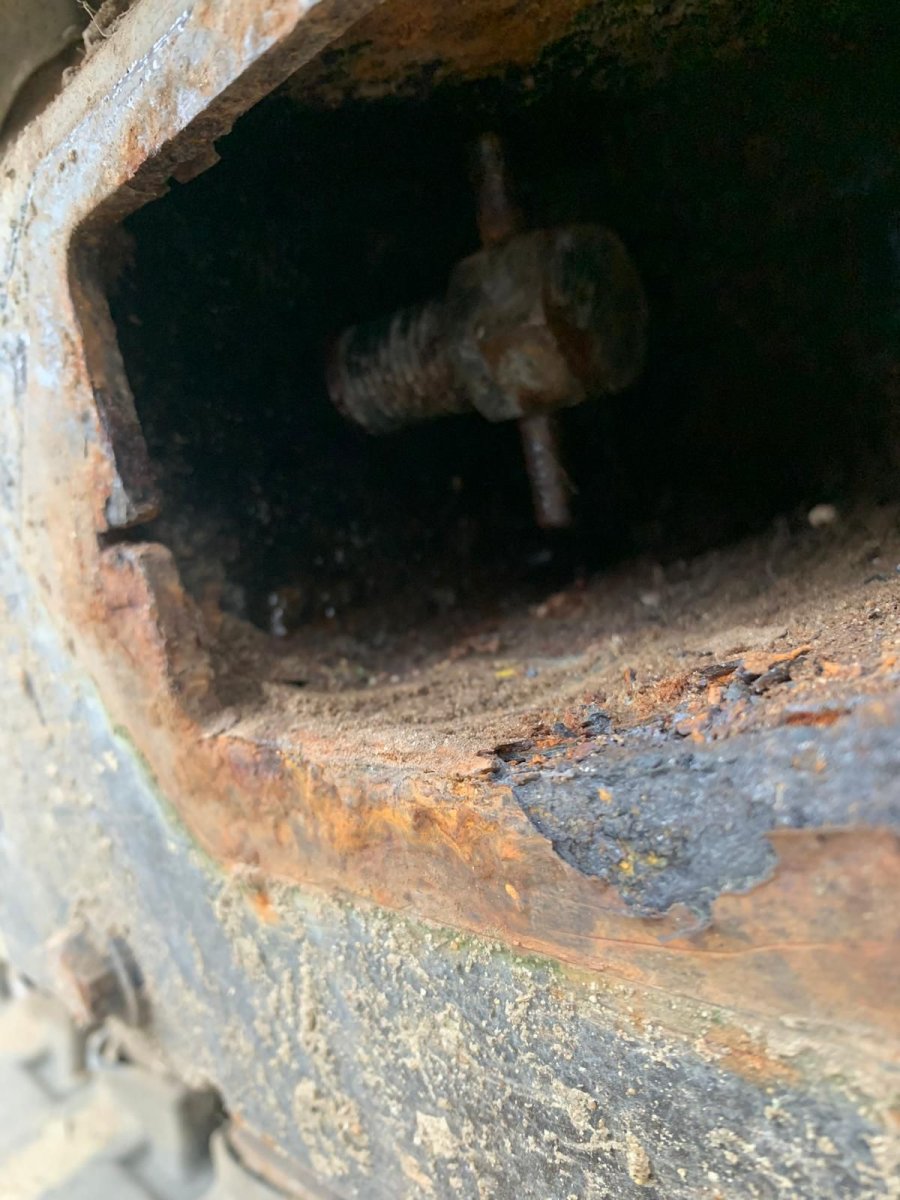
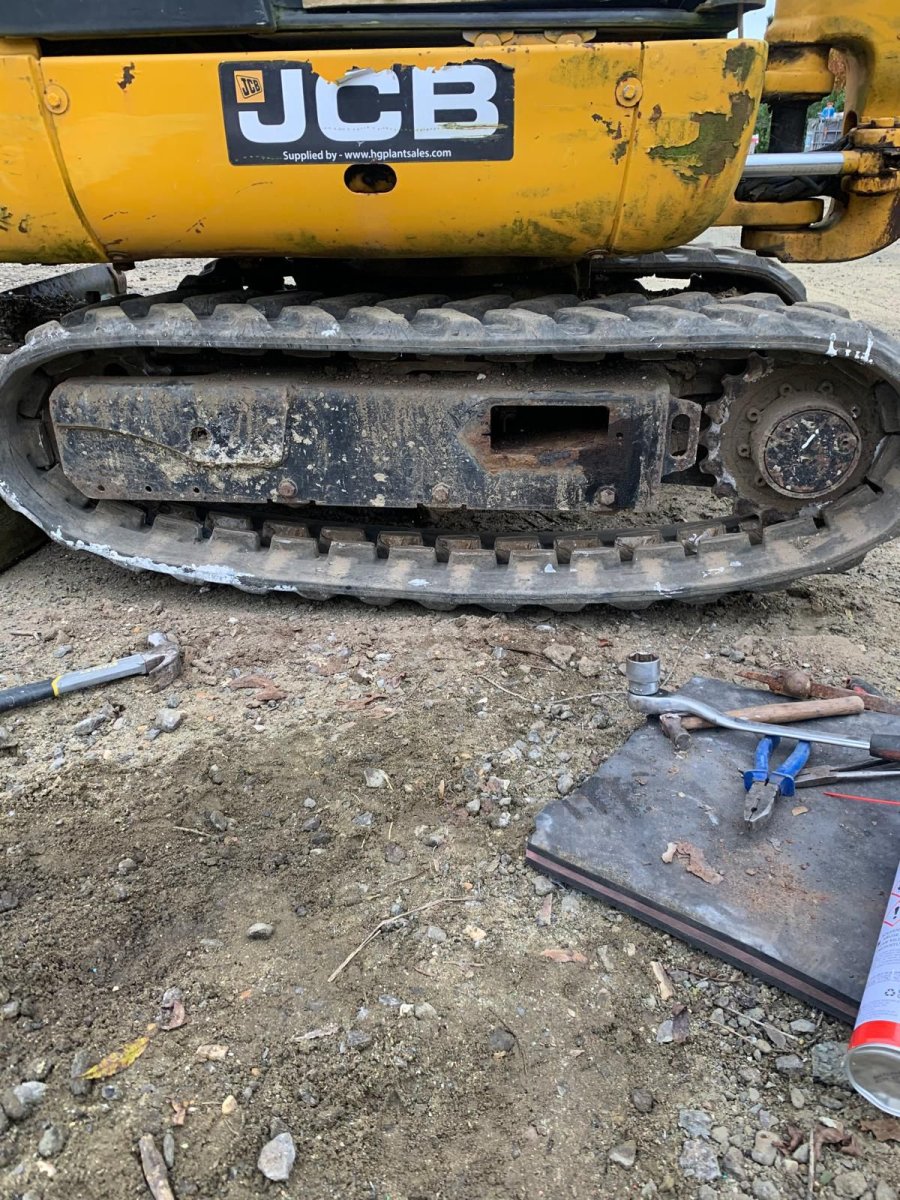
77267f39-121f-447a-b1ef-5e79f3e14a1c.jpg
b33749cb-a5ed-405e-87df-abcd1d30f0d3.jpg
 
doobin

doobin

Well-known member
You can keep adding penetrating oil, leaving it overnight and trying to move it.

Really it wants some oxy to heat it up.you could try leaving a mapp gas torch on it for ten minutes but I doubt it would be enough, it’s a big bolt.
 
Goodwill Man

Goodwill Man

Member
Heating up the bolt...? Good idea. I will give it a go tomorrow with my plumbers gas blower. Thanks
 
T

topkit

Well-known member
You will probably require more heat than a gas torch can produce, Like doobin say give it a good soaking in penetrating oil, if you can get it to move don't just try turning it in one direction back it off again and then a little more then wind it on again and a little more then back off, that way you ate not risking breaking anything, But the best method will be real heat from oxy to get it cherry red.
 
Giles

Giles

Well-known member
Heat it up then melt a wax crayon into it like a kids crayola, penetrates and lubes the threads and doesn’t evaporate like penetrating oil

Then work it back and forth like cutting a thread you get a bit of Scaff tube over your rachet?

 
Goodwill Man

Goodwill Man

Member
Thank you all for your suggestions! I tried applying some heat, but unfortunately, it didn’t work. I don't have oxy welding equipment. The bolt is moving outward, but it is turning back only to its original position and then is completely stuck. I will try wax idea, but not sure where to get it from? I’m not familiar with the tensioning mechanism—is it possible that something other than rust is preventing the bolt from going further inward? If that’s the case, how can I access the mechanism to address the issue? Thanks again!
 
doobin

doobin

Well-known member
Thank you all for your suggestions! I tried applying some heat, but unfortunately, it didn’t work. I don't have oxy welding equipment. The bolt is moving outward, but it is turning back only to its original position and then is completely stuck. I will try wax idea, but not sure where to get it from? I’m not familiar with the tensioning mechanism—is it possible that something other than rust is preventing the bolt from going further inward? If that’s the case, how can I access the mechanism to address the issue? Thanks again!
It’ll just be rust unfortunately.

Where are you? There may be someone with oxy kit nearby.
 
Goodwill Man

Goodwill Man

Member
I managed to move the bolt out approximately 90mm, then cleaned the threads using a small steel brush and applied lubricant. Afterward, I began turning the bolt back in. Despite some resistance, I was able to turn it back until it stopped, leaving about 30mm exposed (as shown in the attached photo). It will not go any further. On the other side the bolt is out about 55mm. However, the bolt's movement hasn’t affected the track tension, which remains as loose as before.

This leads me to suspect that there may be an issue with the tensioning mechanism itself. What are your thoughts?
4743c8d2-d13f-4f2f-9c8f-c5e234dfa8dc.jpg
 
doobin

doobin

Well-known member
I managed to move the bolt out approximately 90mm, then cleaned the threads using a small steel brush and applied lubricant. Afterward, I began turning the bolt back in. Despite some resistance, I was able to turn it back until it stopped, leaving about 30mm exposed (as shown in the attached photo). It will not go any further. On the other side the bolt is out about 55mm. However, the bolt's movement hasn’t affected the track tension, which remains as loose as before.

This leads me to suspect that there may be an issue with the tensioning mechanism itself. What are your thoughts?View attachment 66436
Possibly the idler sliders are jammed solid then. Best start lubing them as much as you can, a few hits with the sledge will help.

If you can get the bolt all the way out the best place to lube would be inside the hole where it pushes upon the sliders.
 
S

Smiffy

Well-known member
Possibly the idler sliders are jammed solid then. Best start lubing them as much as you can, a few hits with the sledge will help.

If you can get the bolt all the way out the best place to lube would be inside the hole where it pushes upon the sliders.

The threaded bar comes out the front the the idler. The nut in the picture is held on to the threaded rod by the roll pin. If the track isn't tensioning and nut jamming I would think it needs further investigation.

Take track off pull idler out end. And a coil spring spring should come out aswell.

Parts diagrams and descriptions in this tread.
 
Goodwill Man

Goodwill Man

Member
Thank you guys ! I am going to take the track off, then try to remove (sliding off) the whole tensioning mechanizm and see why it is not moving even when the bolt is in.
 
Gecko

Gecko

Well-known member
Just a thought - (because this is so much fun) - how about pulling the cover off the other side and giving it a good dose of penatrant. You'll need it moving at some stage and may as well give it a soak.

For interest, every time discussion of these adjusters comes up, there are pics that look something dug out of a Viking burial. Is there a recommended lube / treatment when assembeling?
Without an approved procedure, I'd be generious with Nickel Anti-Sieze, but there may be something better.
 
V8Druid

V8Druid

do it as well as you can,but learn to do it better
The threaded bar comes out the front the the idler. The nut in the picture is held on to the threaded rod by the roll pin. If the track isn't tensioning and nut jamming I would think it needs further investigation.

Take track off pull idler out end. And a coil spring spring should come out aswell.

Parts diagrams and descriptions in this tread.
#6 in that dia. looks to be a one piece, hex headed bolt with the roll pin there to possibly lock rotation once adjusted (sh1t idea)
presumably the nut in the OP's pix is attached to a bulkhead in the carriage and all of the rest of the components in the dia. below are t'other side of said bulkhead with #6 pushing against them to provide compressive force on the idler carrier to tension the track.
if it won't tension after extending the bolt #6, (screwing it into the nut), maybe the spring is broken

1731721390020.png
 
Goodwill Man

Goodwill Man

Member
Hello,

My struggle with this issue continues. After removing the track, I attempted to slide off the front idler, but it is completely seized and refuses to move either out or in. I jet-washed the area and applied diesel to lubricate the rusted slider, followed by penetrating DP60 for added effect.

Next, I used a 2-ton jack to push the element backward, hoping this would free up the mechanism (see attached photo). Unfortunately, none of these efforts have worked.

I’m now wondering if there’s a specialized tool, such as a puller, designed specifically for sliding off the front idler? At this point, I’ve run out of ideas and could really use some advice or suggestions.
945c8e9c-39a0-4a90-ab1d-0d402cb9f19b.jpg
b8ac26bb-237f-4ec5-913f-c87b212676ab.jpg
 
S

Smiffy

Well-known member
Hello,

My struggle with this issue continues. After removing the track, I attempted to slide off the front idler, but it is completely seized and refuses to move either out or in. I jet-washed the area and applied diesel to lubricate the rusted slider, followed by penetrating DP60 for added effect.

Next, I used a 2-ton jack to push the element backward, hoping this would free up the mechanism (see attached photo). Unfortunately, none of these efforts have worked.

I’m now wondering if there’s a specialized tool, such as a puller, designed specifically for sliding off the front idler? At this point, I’ve run out of ideas and could really use some advice or suggestions.View attachment 66454View attachment 66455

At this point you need alot of heat. I would be prepared to buy a new idler assembly as I wouldn't be surprised if it is destroyed being removed
 
V8Druid

V8Druid

do it as well as you can,but learn to do it better
well your idler bearings look pretty fair
wire strop either doubled looped over the hub each side or two shorter strops, one either side ... pull lift attached and t'other end of the pull lift attached to summat solid (tree/vehicle/whatever) and give it some load - dig the blade into the deck if needed and the bucket stretched out and buried .. give it all you dare and then try assaulting whatever you can get a drift to with a large knockometer ... the preload will help immensely
doubled.jpg
 
Bri963

Bri963

Well-known member
I would do what you’re doing, then twat the side of the frame with a sledgehammer, preferably with a bit of thick plate in between so you don’t dent the frame. If you get any movement, put a bar behind the idler, then try to lever it forward. As soon as you see movement in either direction, stop and try it the other way. If you can, move the jack to the inside, then try to hit where you currently have the jack with a sledgehammer and drift. Don’t go mad and dent the frame though, or you’ve got another headache.

No easy way round this one, but as soon as it moves a bit, you’ve got it. I wouldn’t be putting heat to it.

on edit, after another look at the drawing, it’s probably no. 4 that’s jammed in the track frame, not the idler bearing supports. Is it possible to get a long bar in to hit the plate where bolt no.6 pushes it? Possibly tap the frame around where n.4 sits while trying to turn the adjuster screw in?

I am wondering if the square plate on no.4 has sat in the same place so long that it’s sitting in a wear groove at the bottom. If this is the case, and there’s access from underneath, see if you can wedge no.4 upwards while trying to move it. I know this is a lot of words, but best I can do from here in civilisation.
 
Last edited:
Top